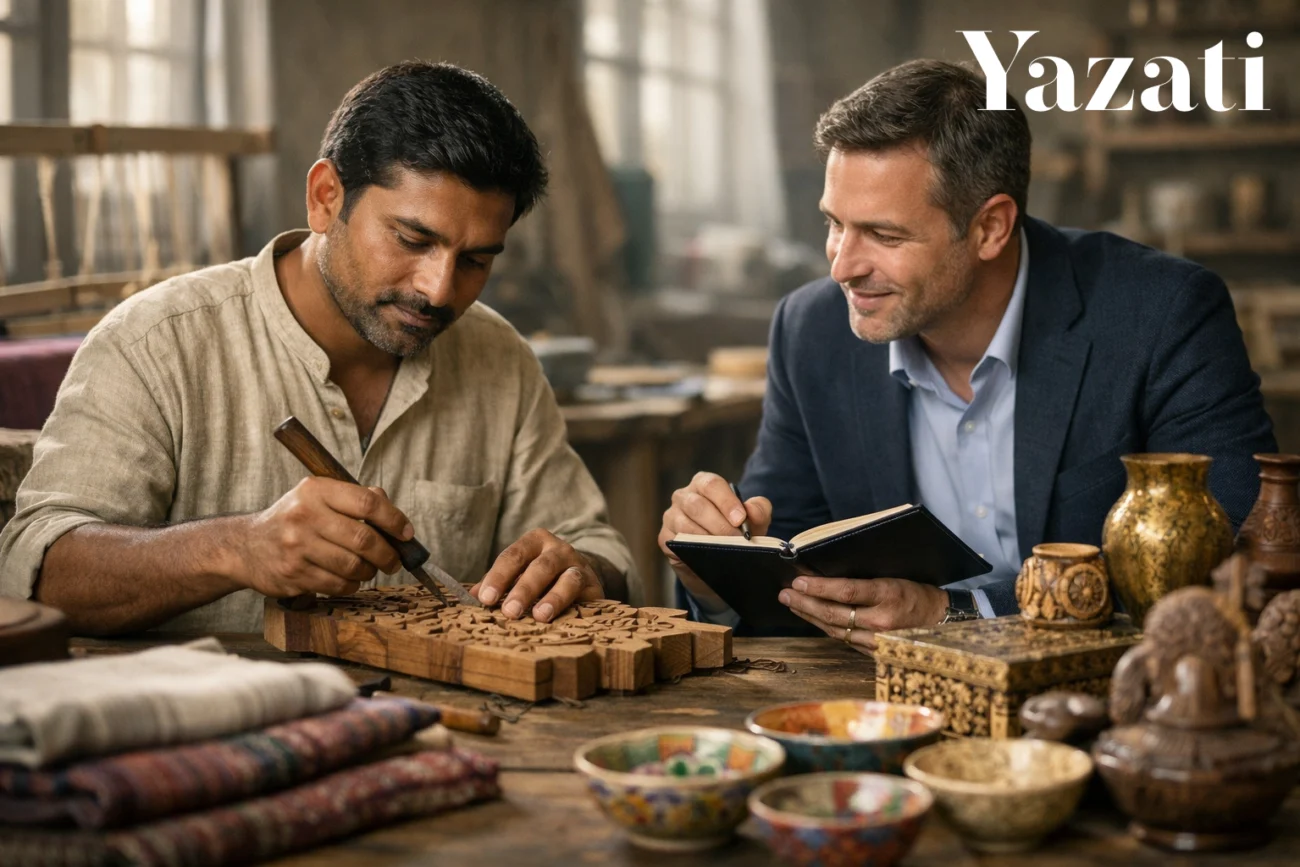
7 Reasons Global Buyers Prefer Indian Artisans Over Mass Producers
Global sourcing is no longer driven solely by speed and volume. Buyers today are focused on authenticity, differentiation, and long-term brand value. This shift explains 7 Reasons Global Buyers Prefer Indian Artisans Over Mass Producers—a preference rooted in both consumer demand and smart commercial strategy.
Artisan production in India offers a unique blend of cultural depth, flexibility, and economic value that mass production often cannot replicate.
Introduction: A Shift in Global Sourcing Priorities
From Efficiency-Only to Value-Driven Buying
For years, mass producers dominated global supply chains by offering speed and uniformity. While these qualities remain important, they no longer guarantee success in competitive retail environments.
Why Mass Production Is Losing Its Edge
Uniform products are easy to compare and discount. As a result, many mass-produced goods struggle with shrinking margins and weak brand loyalty.
Reason 1: Authentic Craftsmanship and Human Touch
The Emotional Power of Handmade Products
Indian artisans create products using skills refined over generations. Each item carries subtle variations that reflect human involvement—something machines cannot replicate.
Why Consumers Value Human Skill
Handmade products feel personal and intentional. This emotional connection often translates into stronger customer loyalty and repeat purchases.
Reason 2: Strong Cultural Identity and Storytelling
Heritage as a Product Advantage
Indian artisan products are deeply rooted in regional traditions, materials, and techniques. This heritage adds authenticity and meaning to every piece.
Storytelling That Drives Retail Engagement
Retailers can share the story behind the craft, enhancing merchandising, marketing, and customer engagement across physical and digital channels.
Reason 3: Built-In Product Differentiation
Escaping Price-Only Competition
Because handcrafted items are never identical, they are harder to commoditize. This reduces direct price comparison and discount pressure.
Standing Out in Crowded Marketplaces
In markets saturated with similar products, artisan goods stand out naturally—without requiring heavy branding spend.
Reason 4: Greater Flexibility and Customization
Adapting Designs for Global Markets
Indian artisans can adjust colors, finishes, and dimensions to suit different regions while preserving craft integrity.
Small-Batch and Limited-Edition Strength
Artisan production supports limited runs and seasonal collections, allowing buyers to test trends with minimal risk.
Reason 5: Ethical and Responsible Production
Supporting Artisan Livelihoods
Sourcing from artisans helps sustain traditional skills and provides stable income to craft communities.
Aligning With Conscious Consumer Values
Consumers increasingly care about how products are made. Ethically produced artisan goods strengthen brand credibility and trust.
Reason 6: High Perceived Value With Competitive Costs
Value Density vs Unit Price
While the unit cost of handmade products may not always be the lowest, their perceived value is significantly higher.
Better Margins Through Craft-Based Products
This value perception allows buyers to achieve healthier margins compared to mass-produced alternatives.
Reason 7: Scalable Sourcing Without Losing Identity
Growing Volumes Responsibly
With proper planning and coordination, Indian artisan sourcing can scale from small collections to global retail programs.
Structure Over Industrialization
Scalability is achieved through organization and process discipline—not by stripping away handcrafted character.
Common Misconceptions About Indian Artisans
“Handmade Means Unreliable”
Reliability depends on planning and structure, not whether a product is handmade or factory-made.
“Artisans Can’t Support Scale”
Artisan sourcing can scale effectively when growth respects capacity and lead times.
FAQs on Sourcing From Indian Artisans
1. Are artisan products suitable for global retailers?
Yes. They perform well in lifestyle, décor, gifting, and e-commerce categories.
2. Do variations create quality risks?
No, when acceptable variation ranges are clearly defined.
3. Can artisan products be customized?
Yes. Customization is one of their strongest advantages.
4. Are artisan goods more expensive?
They offer higher value, not necessarily higher cost.
5. Is ethical sourcing important to buyers today?
Yes. Ethics strongly influence consumer trust and brand loyalty.
6. Can artisan sourcing support repeat orders?
Yes, with realistic planning and long-term relationships.
Conclusion: Artisan Sourcing as a Strategic Advantage
7 Reasons Global Buyers Prefer Indian Artisans Over Mass Producers reflects a fundamental change in global trade. Buyers are choosing authenticity over uniformity, value over volume, and meaning over mass production.
Indian artisans provide what modern markets demand—unique products, cultural depth, ethical appeal, and strong commercial value. For global buyers looking to build resilient brands and sustainable margins, artisan sourcing is no longer an alternative strategy. It is a competitive advantage.
✨ Discover Global Sourcing Excellence with Netyex ✨
Netyex is your trusted B2B sourcing partner, connecting international buyers with India’s finest manufacturers and curated product lines—from handicrafts and home décor to kitchenware, textiles, hospitality essentials, and more. With verified suppliers and end-to-end support, we make global procurement seamless, reliable, and efficient.
👉 Elevate your sourcing experience—explore Netyex today.
📦 Bulk orders & customisation | 🌍 Worldwide delivery | 🤝 Trusted by global buyers
Visit Netyex to source premium Indian products with confidence.