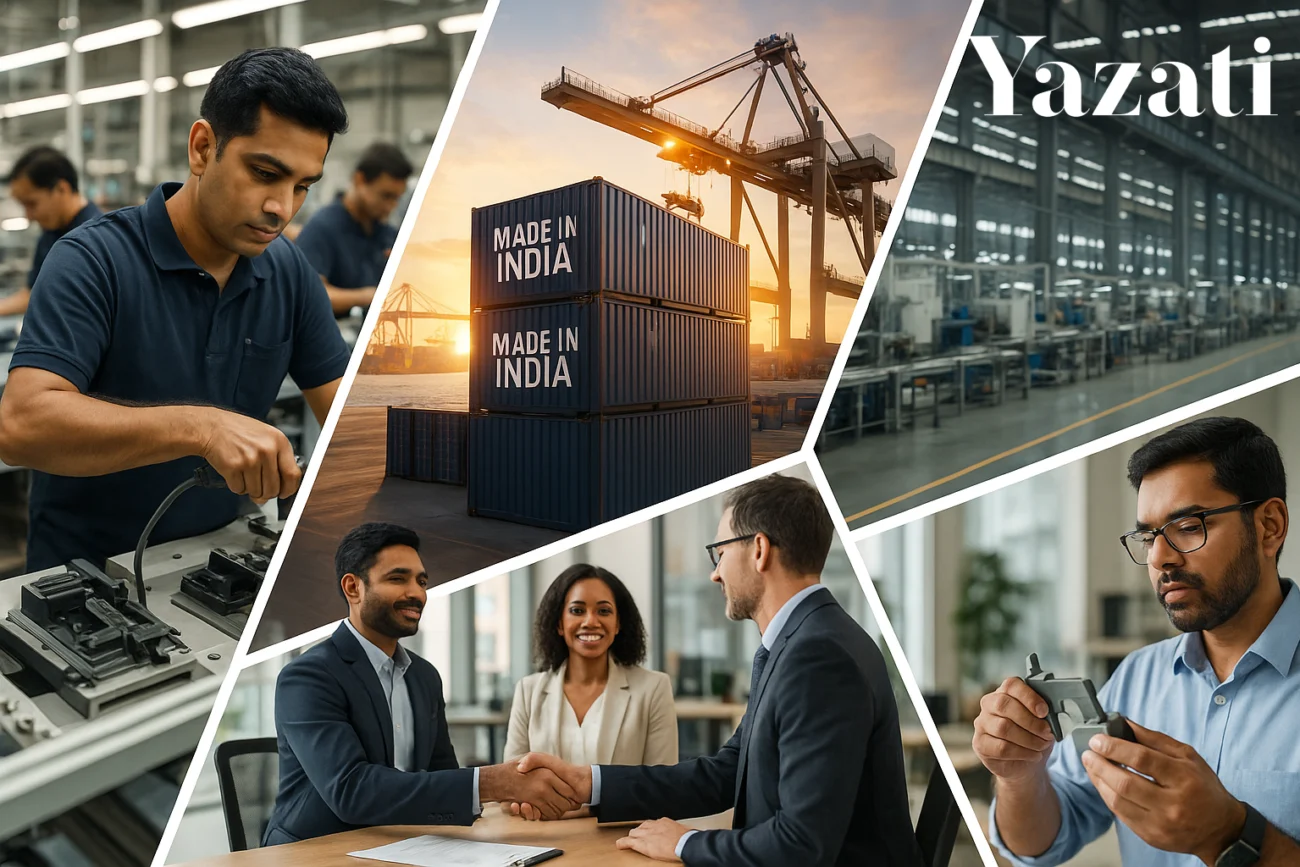
Introduction: The Shift in Global Manufacturing Power
For over three decades, China was the undisputed global manufacturing powerhouse. Its efficient supply chains, vast labor force, and low production costs made it the “factory of the world.” But in recent years, the tide has begun to turn. A new player—India—is rapidly emerging as a strong alternative for global buyers seeking resilient, affordable, and ethical manufacturing solutions.
The global trade environment post-COVID-19, coupled with geopolitical tensions and rising Chinese labor costs, has accelerated this shift. Multinational corporations (MNCs) are increasingly adopting a “China Plus One” strategy, diversifying their sourcing by moving part of their manufacturing to India.
Economic Factors Driving the Shift from China to India
Rising Labor and Production Costs in China
China’s rapid economic growth has pushed up wages, making it less cost-effective for foreign buyers. According to multiple trade reports, Chinese factory wages have increased by over 60% in the past decade, forcing manufacturers to raise prices or relocate.
Energy costs, real estate prices, and regulatory compliance have also climbed, diminishing China’s traditional low-cost appeal.
India’s Cost Advantage and Expanding Industrial Base
In contrast, India offers a 25–30% lower production cost in several sectors, from textiles to electronics. Its massive workforce—young, skilled, and English-speaking—provides a competitive edge for labor-intensive industries.
With the Indian government’s “Make in India” initiative, foreign direct investment (FDI) has surged, leading to the establishment of new factories, supplier networks, and industrial parks.
The Impact of Trade Wars and Tariffs
The U.S.-China trade tensions and global sanctions on Chinese products have prompted many companies to look for stable and neutral sourcing hubs. India’s balanced diplomatic stance and strong international relations make it a safe haven for global buyers.
Manufacturing Infrastructure: Comparing India and China
China’s Mature Industrial Ecosystem
China’s supply chain network is unmatched in maturity—nearly every raw material or component can be sourced domestically. However, heavy centralization in certain provinces has made the system vulnerable to regional disruptions, as seen during COVID-19 lockdowns.
India’s Rapid Industrial Modernization
India is catching up fast. The establishment of Special Economic Zones (SEZs) in Gujarat, Tamil Nadu, and Maharashtra has significantly improved logistics efficiency and export potential.
The government’s Production Linked Incentive (PLI) schemes have attracted top manufacturers in sectors like mobile phones, solar modules, and semiconductors.
Government Policies and Trade Incentives
India’s PLI Scheme and Make in India Vision
Introduced in 2020, the PLI scheme provides financial incentives for companies manufacturing in India. This has attracted tech giants like Apple, Samsung, and Dixon Technologies to expand their Indian operations.
China’s Policy Shifts and Global Scrutiny
Meanwhile, China’s tightening data laws, export controls, and regulatory crackdowns on foreign firms have raised compliance risks. Buyers seeking transparency and ease of business are now turning to India, where government policies are becoming increasingly business-friendly.
Supply Chain Resilience and Diversification
Post-COVID Lessons
The pandemic exposed how overdependence on a single country for manufacturing can disrupt the global economy. Companies are now prioritizing supply chain resilience, not just cost savings.
India’s Role in the “China Plus One” Strategy
India’s growing manufacturing capacity and global partnerships make it the perfect candidate for diversification. Electronics, automotive, and pharmaceutical sectors are already seeing major investments from global players.
Technology and Innovation in Indian Manufacturing
India’s manufacturing industry is no longer defined by manual labor alone. Factories across Bengaluru, Pune, and Noida are integrating AI, robotics, and IoT-driven automation. The rise of Industry 4.0 technologies has positioned India as an innovation hub, supported by its thriving startup ecosystem.
Sector-Wise Comparison: India vs. China
India’s growing manufacturing ecosystem is not a one-size-fits-all story — it varies across sectors. Here’s how India stacks up against China in key industries where global buyers are making the switch.
Textiles and Apparel Manufacturing
For decades, China dominated textile exports, but labor costs and environmental regulations have eroded its competitive edge. India, with its rich cotton production base, skilled artisans, and government subsidies under the Technical Textiles Mission, is reclaiming its role as a global textile hub.
- India’s textile exports reached $44 billion in FY 2024, and the trend continues upward.
- Buyers are attracted by India’s focus on sustainable fabrics and eco-friendly dyeing technologies.
Electronics and Semiconductor Industries
China still leads in electronics manufacturing, but India is catching up rapidly. Under the PLI scheme, India’s electronics exports crossed $25 billion in 2024, driven by giants like Apple, Foxconn, and Tata Electronics setting up assembly lines.
India’s semiconductor policy aims to make it a $100 billion industry by 2030, supported by government-backed manufacturing clusters in Gujarat and Tamil Nadu.
Automotive and EV Manufacturing
India has become the world’s third-largest automotive market, surpassing Japan in 2024.
- Domestic giants like Tata Motors and Mahindra are competing globally in the EV sector.
- Foreign brands, including Hyundai and Suzuki, are expanding production facilities for both local and export markets.
The combination of affordable labor, green mobility incentives, and rising domestic demand gives India a clear edge in automotive growth potential.
Pharmaceuticals and Chemicals
India’s pharmaceutical dominance isn’t new—it’s often called the “Pharmacy of the World.”
With over 50% of global vaccine demand and 20% of generic drug exports coming from India, buyers prefer Indian suppliers for their regulatory compliance, affordability, and quality standards.
Meanwhile, China faces stricter environmental controls on chemical and pharma plants, adding to production costs.
Labor Force and Skill Development
China’s Aging Workforce Challenge
China’s working-age population has been declining since 2018, creating significant labor shortages in factories. The average manufacturing worker’s age in China is now over 40, raising concerns about long-term productivity.
India’s Young Demographic Advantage
In contrast, India’s median age is just 28 years, providing a massive, youthful labor pool. This demographic dividend gives India an unmatched advantage in labor-intensive industries such as textiles, assembly, and consumer goods.
Skill Development Initiatives
Programs like Skill India, PMKVY (Pradhan Mantri Kaushal Vikas Yojana), and National Apprenticeship Promotion Scheme (NAPS) are equipping millions of young Indians with industry-ready skills.
These initiatives have helped improve productivity, reduce training costs for foreign companies, and create a more reliable and skilled workforce than ever before.
Environmental Sustainability and Green Manufacturing
China’s Environmental Compliance Costs
China’s rapid industrialization has led to environmental degradation and stricter regulatory oversight.
While this shift promotes sustainability, it has also increased operational costs, especially for industries like chemicals, steel, and textiles.
India’s Push for Renewable Energy and ESG Standards
India is investing heavily in renewable energy, aiming for 500 GW of clean power capacity by 2030.
Manufacturers in India are adopting solar energy, waste recycling, and green building standards, aligning with global buyers’ ESG (Environmental, Social, and Governance) priorities.
This eco-friendly focus not only helps attract Western buyers but also positions India as a sustainable alternative to China’s industrial model.
Challenges India Still Faces
While India’s progress is impressive, challenges remain before it can fully rival China’s manufacturing might.
Infrastructure Gaps and Logistics Bottlenecks
- Port congestion and uneven road quality can still delay exports.
- Freight costs within India are often higher than in China.
However, initiatives like Gati Shakti, Dedicated Freight Corridors, and new logistics parks are expected to improve infrastructure efficiency by 2026.
Bureaucratic Delays and Regulatory Hurdles
India’s bureaucratic system can be complex, and navigating permits can be time-consuming.
Nonetheless, reforms such as Digital India and single-window clearance systems are simplifying processes for foreign investors.
Despite these hurdles, the cost advantages and policy reforms outweigh the obstacles for most global buyers.
Case Studies: Global Brands Shifting to India
Apple and Foxconn’s Expansion
Apple, once heavily dependent on Chinese factories, now manufactures over 25% of its iPhones in India.
Foxconn and Pegatron have expanded operations in Tamil Nadu and Karnataka, creating thousands of jobs and building local supplier networks.
IKEA and Other Global Brands
Swedish furniture giant IKEA has ramped up its Indian sourcing by over 50% since 2022, partnering with local manufacturers for furniture, textiles, and home goods.
Similarly, Samsung, Dell, and Toyota have invested in Indian plants to diversify risk and reduce dependence on China.
These success stories demonstrate that India is no longer an alternative — it’s becoming a preferred manufacturing destination.
The Future of Global Manufacturing: India’s Path Forward
India’s manufacturing sector is forecast to grow by 12–14% annually over the next decade.
With robust infrastructure development, supportive government policies, and strong FDI inflows, India is poised to become the next global manufacturing superpower.
If India continues to invest in infrastructure, education, and innovation, it can achieve what once seemed impossible — rivaling China as the world’s manufacturing leader.
FAQs: India vs. China Manufacturing
1. Why are companies leaving China for India?
Rising labor costs, trade tensions, and supply chain risks are pushing companies to explore India, which offers lower costs, young talent, and stable policies.
2. Is India ready to replace China in manufacturing?
Not entirely yet — but India is rapidly catching up with strong government support, infrastructure upgrades, and policy reforms.
3. Which industries are moving from China to India?
Electronics, textiles, automotive, and pharmaceuticals are among the fastest-growing industries shifting to India.
4. What is the “China Plus One” strategy?
It’s a diversification approach where companies keep some production in China but move part of it to another country like India to reduce risk.
5. Are Indian products as reliable as Chinese ones?
Yes. Indian manufacturers increasingly adhere to international quality standards, and many now hold ISO and global certifications.
6. How does India’s workforce compare to China’s?
India has a younger, English-speaking workforce, while China faces an aging demographic and rising wage demands.
Conclusion: The Dawn of India’s Manufacturing Era
The global manufacturing landscape is undergoing a historic transformation. India vs. China is no longer just a comparison—it’s a reflection of how global trade dynamics are evolving.
With its cost efficiency, youthful labor force, digital infrastructure, and policy reforms, India has positioned itself as the next big manufacturing hub.
Buyers worldwide are no longer asking “Can India replace China?”—they’re asking “How fast can we make the shift?”
✨ Discover Global Sourcing Excellence with Netyex ✨
Netyex is your trusted B2B sourcing partner, connecting international buyers with India’s finest manufacturers and curated product lines—from handicrafts and home décor to kitchenware, textiles, hospitality essentials, and more. With verified suppliers and end-to-end support, we make global procurement seamless, reliable, and efficient.
👉 Elevate your sourcing experience—explore Netyex today.
📦 Bulk orders & customisation | 🌍 Worldwide delivery | 🤝 Trusted by global buyers
Visit Netyex to source premium Indian products with confidence.