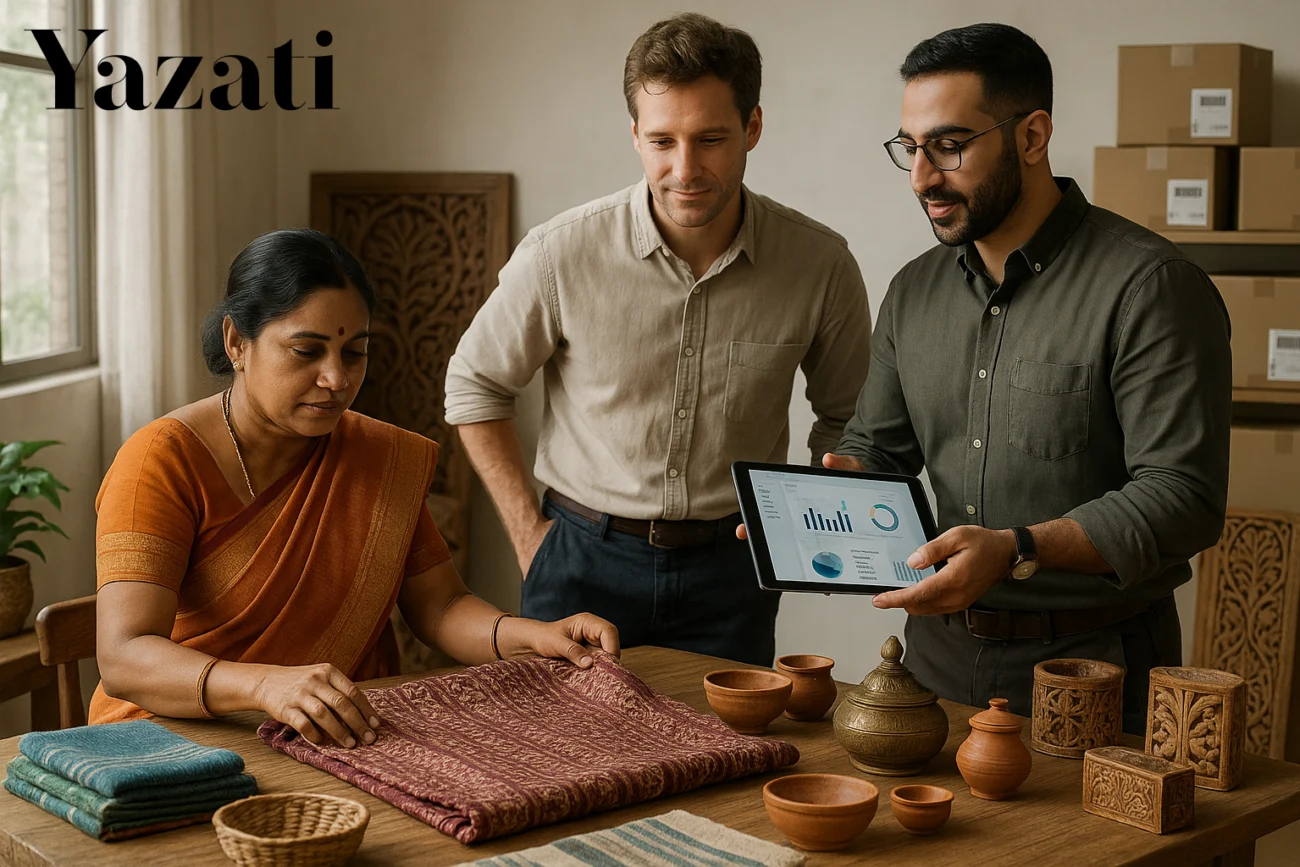
How Yazati Bridges India’s Artisan Supply with Global Demand opens a window into how a modern export-focused company transforms centuries-old craft into boutique and bulk products for global homes, hotels, and retailers. In the first lines, it’s important to note that Yazati positions itself as a bridge between rural and urban India’s makers and international buyers seeking handcrafted home décor, textiles, and hospitality essentials.
Introduction: The Opportunity in Indian Craft Exports
India’s craft tradition is vast — from hand-carved wood and brassware to block-printed textiles and handwoven rugs. Global consumers and businesses increasingly prize authenticity, sustainability, and storytelling, creating a strong market for artisanal goods. Brands like Yazati tap this appetite by aggregating small-scale craftsmanship into export-ready product lines that satisfy global quality, scale, and delivery expectations. Market trends show the global handmade/home-decor sector growing rapidly, making the model commercially viable while offering social impact.
Who is Yazati? A Snapshot
Yazati is an India-based exporter and curator of handcrafted home décor, textiles, and hospitality essentials. The company curates assortments across multiple categories and supplies bulk orders to international buyers. Their online presence and content explain that they work directly with artisans and export to many countries, positioning themselves as both a sourcing partner and a brand storyteller for Indian craft. Recent company posts highlight export operations and community programs aimed at empowering makers.
The Supply Side: India’s Artisan Ecosystem
India’s artisan ecosystem is geographically and technically diverse. Craft clusters — think Kutch textiles, Varanasi silks, Rajasthani block-printing, and Saharanpur woodwork — each have distinct techniques and constraints. Artisans often face seasonal work, low bargaining power, and limited access to consistent buyers. A company that wants to connect these makers with global demand must navigate local supply variability while preserving craft integrity.
Demand Side: What Global Buyers Want
International buyers vary widely — boutique retailers, large home-decor chains, hospitality procurement teams, and interior designers. Common requirements include consistent quality, compliance with export standards, predictable lead times, and the ability to customize designs and quantities. Increasingly, buyers ask for traceability, eco-friendly materials, and stories that explain provenance — all areas where artisan-made products can excel.
Sourcing Strategy: Direct Partnerships with Artisans
Yazati’s sourcing approach centers on direct partnerships. Instead of purely acting as a middleman, they build relationships with guilds, small cooperatives, and independent artisan households. This allows them to secure exclusive designs, manage quality at the source, and reduce markup layers. They also run product development cycles — sampling, testing, and design tweaks — to align traditional techniques with buyer specs. This direct sourcing model helps stabilize artisan incomes by smoothing orders across seasons.
Product Curation: From Tradition to Market Fit
Raw craft needs curation to succeed in global markets. Yazati curates by selecting categories that translate well across cultures (tableware, pillows, small furniture, décor accents) and then works with artisans to adapt colorways, finishes, and sizes. They balance authenticity with modern design sensibilities to create product lines that are both marketable and respectful of craft languages.
Quality Assurance and Compliance
For exports, quality assurance is non-negotiable. Yazati implements layered QA: in-workshop checks, centralized inspection before consolidation, and pre-shipment inspections aligned with buyer standards. They also manage documentation for international shipments — material safety, customs paperwork, and any certifications required by destination countries. Traceability — tagging products with maker details or production batch info — increases buyer confidence and supports premium pricing.
Technology & Operations: Scaling an Artisan Supply Chain
Technology creates scale without stripping artisans of their craft. Yazati uses digital catalogues and order-management systems to present SKUs, process POs, and manage lead times. Digitization helps smaller producers receive standardized orders, track payments, and monitor production schedules. On the backend, inventory forecasting tools and demand signals from international buyers help Yazati batch production intelligently, reducing waste and limiting cash-flow stress on artisan partners.
Logistics & Global Distribution
Consolidation hubs are essential. Yazati consolidates small-batch outputs from multiple villages into centrally managed shipments — optimizing packaging to protect delicate handmade items and meet containerization rules. For global deliveries, they coordinate with freight forwarders and customs brokers, ensuring timelines align with buyer windows. By offering FOB/CIF options and handling export compliance, Yazati removes friction for international buyers who otherwise must navigate complex Indian export logistics.
Pricing, Margins & Fair Pay
A transparent pricing framework helps balance buyer expectations and artisan livelihoods. Yazati appears to follow a model where costing includes raw material, labor, quality-control, and export overheads. Part of their value proposition is offering fair prices to makers while keeping the final pricing competitive for bulk buyers. Transparent contracts, timely payments, and periodic premium payments for design or quality improvements help sustain the artisan network.
Storytelling & Marketing: Placing Makers at the Centre
Storytelling converts provenance into price. Yazati’s blogs and product pages foreground artisan stories, craft processes, and the heritage behind each item. This content helps B2B and D2C buyers value the product beyond utility — as culture, as craft, and as a responsible purchase. Visual assets, product narratives, and maker profiles form the backbone of the brand’s customer-facing communication.
Partnerships: Hotels, Retailers, Designers
A smart sales playbook includes multiple channels. Yazati works with hospitality procurement (hotels that need bulk, consistent supplies), specialty retailers, and designers who want curated, authentic lines. Customization options — bespoke sizes, hotel-grade durability finishes, and branded packaging — increase appeal to institutional buyers, while curated collections suit retail and e-commerce.
Sustainability & Social Impact
Sustainability is both ethical and commercial. Yazati emphasizes eco-friendly materials and livelihood programs that train artisans in greener techniques. Their model reportedly creates measurable impact: steady orders, skills training, and better pay. This social narrative strengthens their proposition to conscious buyers who increasingly require environmental and social governance in their supply chains.
Risk Management & Resilience
Handicraft supply chains face seasonality, raw-material fluctuations, and transport disruptions. Yazati mitigates these by diversifying artisan sources across regions, maintaining buffer inventory for core SKUs, and using flexible shipping solutions. Regular quality audits and contingency sourcing plans reduce the risk of single-cluster dependency.
Measurable Outcomes: Export Reach & Metrics
According to their published content, Yazati exports to multiple countries and highlights reach and impact metrics (countries served, product categories exported, and community programs). These results show how aggregation + curation + logistics can scale artisan products from village workshops to global hotel rooms and retail shelves.
The Road Ahead: Scaling Responsibly
Future growth for companies like Yazati will likely include deeper tech investments (AI for demand forecasting, digital twin catalogs), more rigorous sustainability certifications, and strategic partnerships with global retail chains. Importantly, scaling responsibly means preserving craft identities and ensuring artisans benefit proportionally as margins expand.
Frequently Asked Questions (FAQs)
Q1: What kinds of products does Yazati export?
A1: Yazati exports handcrafted home décor, textiles, tableware, wooden furniture, carpets, and hospitality essentials — curated for international buyers.
Q2: Does Yazati work directly with artisans?
A2: Yes — Yazati builds direct partnerships with artisan groups, cooperatives, and individual makers to source authentic handcrafted products and ensure quality and fair pay.
Q3: Which countries does Yazati ship to?
A3: Yazati’s content states export activity across multiple countries (their blog mentions exports to 40+ countries), serving global retail and hospitality markets.
Q4: How does Yazati ensure product quality for bulk orders?
A4: They use in-workshop checks, centralized inspections, and pre-shipment QA aligned with buyer specifications, plus traceability mechanisms.
Q5: Can buyers request custom designs or private-label orders?
A5: Yes — Yazati supports custom and hospitality-grade sourcing, including bespoke sizing, finishes, and branding for large clients.
Q6: How does working with Yazati benefit artisans?
A6: Benefits include stable orders, training opportunities, better pay structures, market exposure, and access to export-grade quality standards.
Q7: Are Yazati’s products sustainable?
A7: Yazati emphasizes eco-friendly materials and sustainable craft practices in their product lines and artisan programs; buyers should check product-level certifications when needed.
Conclusion
Yazati presents a modern playbook for turning India’s artisanal wealth into products that meet global demand — without stripping craft of its soul. Through direct sourcing, curated design, quality systems, logistics consolidation, and storytelling, the company demonstrates how commerce and compassion can coexist. For global buyers seeking authenticity with scale, platforms like Yazati reduce friction — delivering handcrafted goods that come with provenance, social impact, and export readiness. If you’re a buyer or a maker wanting specifics, Yazati’s site and blog contain practical guides and company updates that are worth a look.
✨ Discover Global Sourcing Excellence with Netyex ✨
Netyex is your trusted B2B sourcing partner, connecting international buyers with India’s finest manufacturers and curated product lines—from handicrafts and home décor to kitchenware, textiles, hospitality essentials, and more. With verified suppliers and end-to-end support, we make global procurement seamless, reliable, and efficient.
👉 Elevate your sourcing experience—explore Netyex today.
📦 Bulk orders & customisation | 🌍 Worldwide delivery | 🤝 Trusted by global buyers
Visit Netyex to source premium Indian products with confidence.