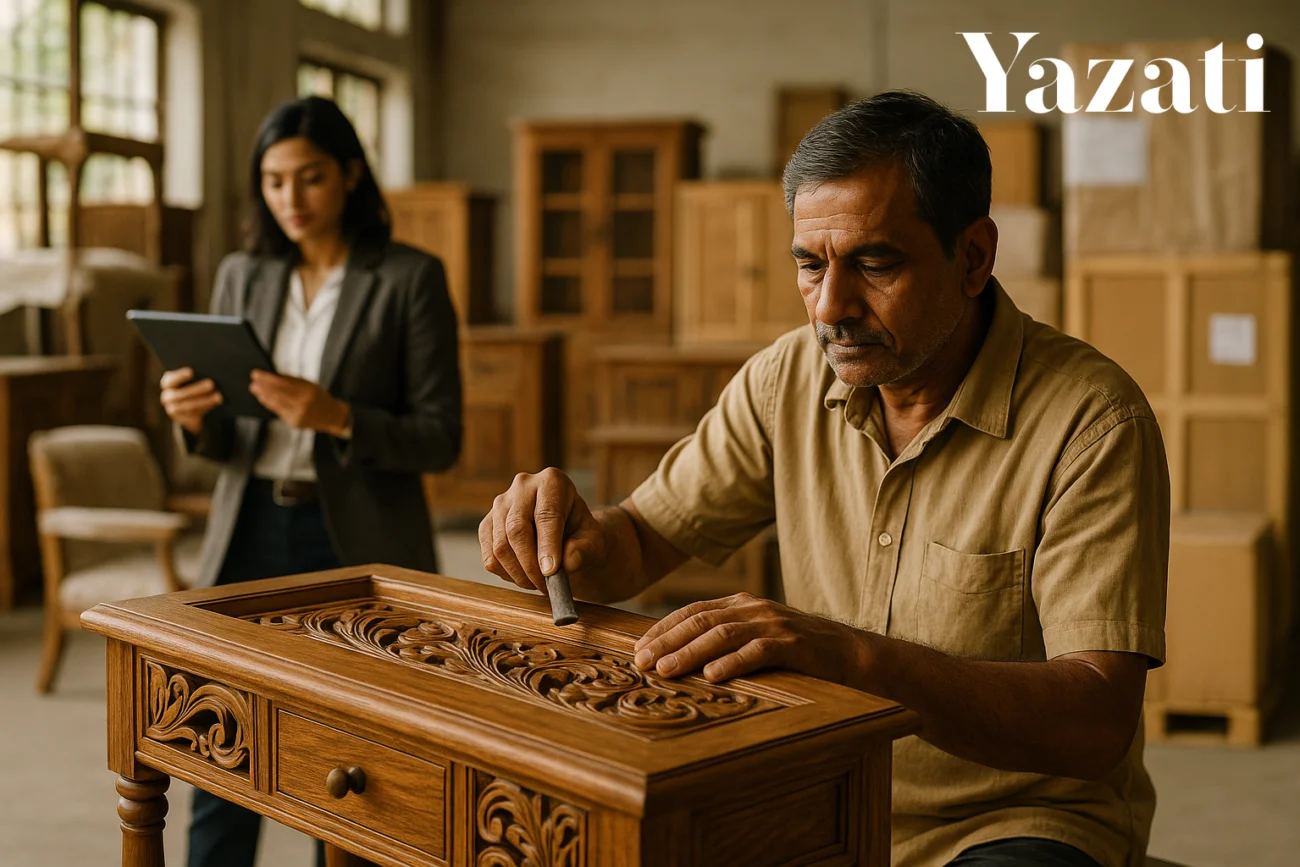
Origins of India’s Handcrafted Furniture Tradition
Historical and Cultural Foundations
Furniture making in India has deep historical roots. Traditional furniture was crafted for palaces, temples, merchants, and households, often reflecting local culture, climate, and lifestyle. Pieces were built to last generations, emphasizing durability, balance, and ornamentation.
This legacy established a strong foundation of woodworking and metalworking skills that continue to define Indian handcrafted furniture today.
Regional Furniture Craft Clusters
Different regions developed distinctive furniture styles—ranging from robust wooden forms to intricately carved pieces and metal-accented designs. These regional clusters became centers of specialized skills, creating a diverse craft ecosystem that later supported export growth.
Transition from Domestic Craft to Export Industry
Early Export Demand and Market Discovery
India’s handcrafted furniture entered global markets as international buyers began seeking alternatives to mass-produced furniture. Early demand came from buyers looking for:
- Unique, character-rich pieces
- Handcrafted authenticity
- Cultural depth
This demand marked the shift from purely domestic craft to export-oriented production.
Role of Artisans in Global Trade
Artisans became central to India’s export success. Their ability to translate traditional skills into export-ready products allowed handcrafted furniture to meet international expectations while retaining originality.
Design Evolution for International Markets
From Traditional Forms to Global Aesthetics
While early exports leaned heavily on traditional designs, global markets soon demanded adaptability. Indian furniture makers evolved by:
- Simplifying silhouettes
- Refining proportions
- Reducing excessive ornamentation
The result was furniture that felt global in form yet artisanal in soul.
Customization and Buyer-Led Design
One of India’s key export strengths is customization. Buyers can request changes in:
- Dimensions and finishes
- Materials and textures
- Design details
This flexibility makes Indian handcrafted furniture highly attractive for international retailers and hospitality projects.
Materials and Craftsmanship at the Core
Wood, Metal, and Mixed-Material Mastery
Indian handcrafted furniture often uses:
- Solid wood
- Metal frameworks
- Mixed materials and natural textures
This material diversity supports a wide range of global interior styles.
Handcraft Techniques That Add Value
Techniques such as hand carving, joinery, distressing, and finishing add depth and individuality. These handcrafted details cannot be replicated by mass manufacturing, making each piece distinctive.
Production Ecosystem and Scalability
Cluster-Based Manufacturing Model
India’s furniture exports benefit from a cluster-based model where artisans, workshops, and finishing units operate within close proximity. This supports:
- Skill specialization
- Faster coordination
- Consistent quality output
Clusters enable efficient export production without centralizing everything into large factories.
Scaling Handcrafted Production for Exports
Despite being handcrafted, Indian furniture production can scale. Work is distributed across multiple artisan units, allowing:
- Large export orders
- Repeat programs
- Seasonal demand fulfillment
This balance of handcraft and scale is rare globally.
Why Global Buyers Choose Indian Handcrafted Furniture
Authenticity, Character, and Storytelling
Global buyers value Indian furniture for its:
- Authentic handcrafted character
- Visible human touch
- Cultural and material storytelling
These elements resonate strongly with modern consumers seeking meaning in design.
Value, Flexibility, and Volume Capability
Compared to other handcrafted regions, India offers:
- Strong value for craftsmanship
- Flexibility in production
- Ability to handle both small and large orders
This combination is a major competitive advantage.
Sustainability and Responsible Craft
Use of Natural and Reclaimed Materials
Sustainability is inherent in much of India’s handcrafted furniture. Common practices include:
- Use of natural materials
- Reclaimed or recycled wood
- Low-energy hand processes
These practices align well with global sustainability expectations.
Longevity and Conscious Consumption
Handcrafted furniture is built for longevity. Durable construction and timeless design encourage long-term use, reducing the cycle of replacement common with mass-produced furniture.
Challenges and Adaptation in Export Markets
Quality Consistency and Compliance
Export growth has required improvements in:
- Quality control systems
- Standardization of dimensions and finishes
- Documentation and compliance discipline
Indian manufacturers have adapted to meet these requirements while preserving craftsmanship.
Evolving Buyer Expectations
Global buyers now expect:
- Design innovation
- Consistent lead times
- Ethical and sustainable practices
Meeting these expectations has pushed the industry toward continuous improvement.
The Future of India’s Handcrafted Furniture Exports
Design-Led Growth and Premium Positioning
The future lies in moving beyond price-driven exports toward:
- Design-led collections
- Premium and luxury positioning
- Brand-driven storytelling
Indian handcrafted furniture is increasingly positioned as a lifestyle choice, not just a product.
Strengthening India’s Global Identity
As global demand for authentic, sustainable décor grows, India’s handcrafted furniture industry is poised to strengthen its identity as a trusted source of timeless design and artisanal excellence.
Frequently Asked Questions (FAQs)
1. Is Indian handcrafted furniture still relevant in modern interiors?
Yes. Contemporary designs blend seamlessly with modern spaces.
2. Can handcrafted furniture be produced at scale?
Yes. India’s cluster-based model enables scalable handcrafted production.
3. Is Indian furniture considered premium internationally?
Yes. Many collections are positioned in premium and luxury segments.
4. How sustainable is handcrafted furniture from India?
Highly sustainable due to natural materials and long product life.
5. Do global buyers demand customization from India?
Yes. Customization is a major reason buyers source from India.
6. What differentiates Indian handcrafted furniture from mass-produced alternatives?
Authenticity, craftsmanship, character, and longevity.
Conclusion
The Export Story Behind India’s Handcrafted Furniture Industry is a story of evolution, resilience, and creative adaptation. By transforming traditional craftsmanship into globally relevant design, India has built a powerful export sector that balances heritage with modern living.
As global consumers increasingly value authenticity, sustainability, and design depth, Indian handcrafted furniture stands out as more than an export product—it is a cultural ambassador, carrying the story of skilled hands and timeless artistry into homes around the world.
✨ Discover Global Sourcing Excellence with Netyex ✨
Netyex is your trusted B2B sourcing partner, connecting international buyers with India’s finest manufacturers and curated product lines—from handicrafts and home décor to kitchenware, textiles, hospitality essentials, and more. With verified suppliers and end-to-end support, we make global procurement seamless, reliable, and efficient.
👉 Elevate your sourcing experience—explore Netyex today.
📦 Bulk orders & customisation | 🌍 Worldwide delivery | 🤝 Trusted by global buyers
Visit Netyex to source premium Indian products with confidence.