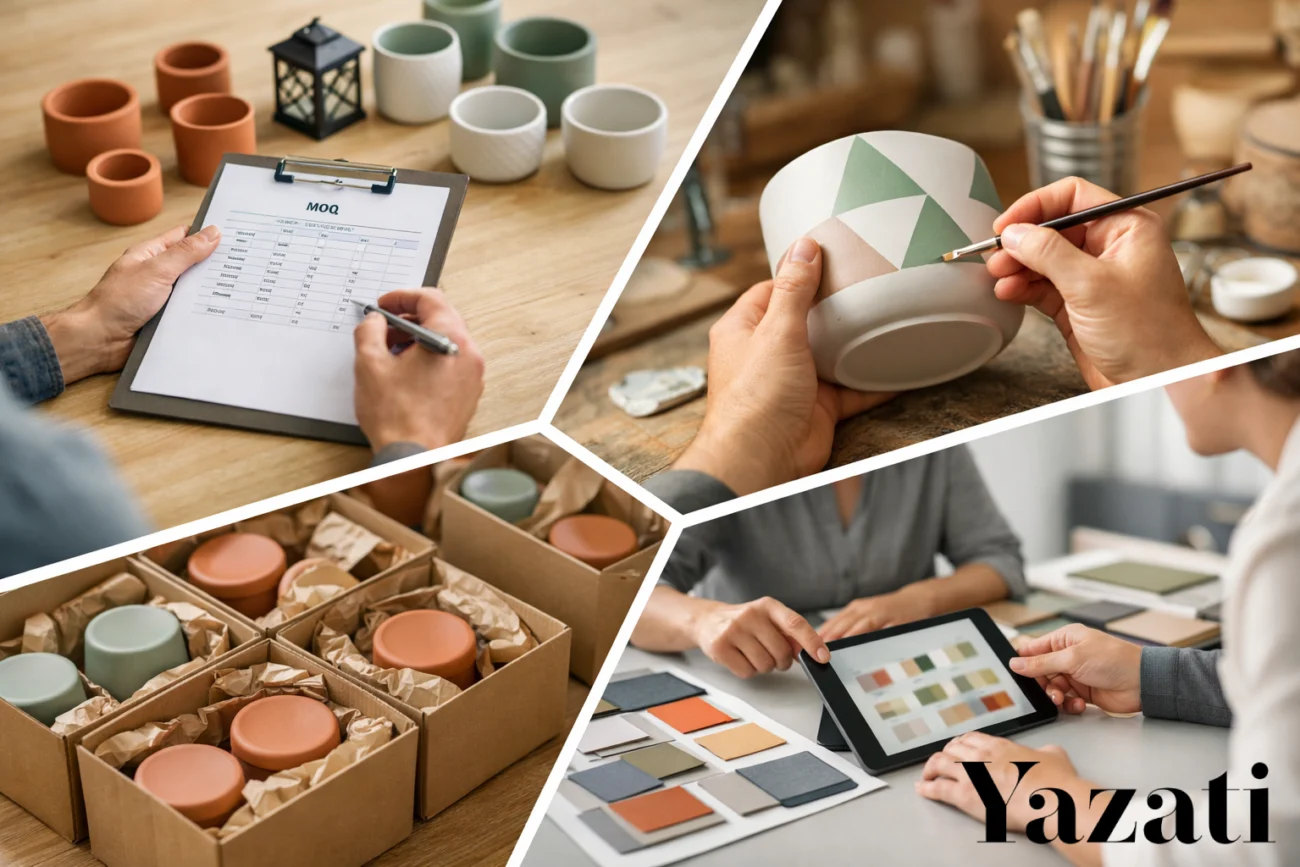
Introduction to MOQ and Customization Challenges
Garden décor imports offer strong profitability, but managing Minimum Order Quantities (MOQ) and customization can be complex. Many importers struggle with large production requirements while trying to maintain flexibility in design and branding.
Understanding How to Manage MOQ and Customization in Garden Decor Imports allows buyers to balance supplier requirements with market demand. Without proper planning, high MOQs can tie up capital, while excessive customization can increase costs and delays.
Strategic negotiation and careful planning reduce risk and improve profit margins.
Understanding MOQ in International Trade
MOQ refers to the minimum quantity a supplier requires per order. It exists because manufacturers must cover:
- Raw material purchasing
- Machine setup costs
- Labor allocation
- Packaging preparation
- Production efficiency thresholds
Suppliers prefer larger runs to reduce per-unit costs.
For importers, high MOQs may create inventory risk if demand is uncertain.
The Complexity of Custom Garden Décor
Customization in garden décor often involves:
- Color changes
- Logo printing
- Engraving
- Packaging adjustments
- Material upgrades
- Size modifications
Each customization element increases:
- Production time
- Setup cost
- Quality control requirements
- Communication complexity
Balancing personalization and practicality is key.
Step 1: Understand Supplier Cost Drivers
Before negotiating, understand what influences MOQ.
Ask suppliers about:
- Material procurement quantities
- Tooling and mold costs
- Setup time
- Production cycle efficiency
- Labor intensity
When you understand cost drivers, you negotiate from knowledge rather than pressure.
Step 2: Align MOQ with Market Demand
Accurate demand forecasting helps manage inventory risk.
Analyze:
- Previous seasonal sales
- Market trends
- Competitor offerings
- Retail partner commitments
- Pre-order opportunities
Import quantities should reflect realistic sales projections.
Over-ordering reduces cash flow flexibility.
Step 3: Negotiate MOQs Strategically
Effective negotiation techniques include:
- Offering long-term purchase commitments
- Combining multiple designs into one order
- Sharing forecast plans with suppliers
- Accepting partial customization in exchange for lower MOQs
- Requesting trial production quantities
Suppliers often show flexibility when they see future business potential.
Relationship-based negotiation works better than price pressure alone.
Step 4: Combine SKUs to Meet MOQ
Mixed container or mixed SKU strategies allow flexibility.
Instead of ordering one large design quantity:
- Combine different colors
- Mix multiple sizes
- Add complementary products
- Diversify product variations
This strategy helps meet supplier MOQ while reducing single-product risk.
It also expands retail offerings.
Step 5: Start with Standard Designs Before Customization
One of the smartest ways to apply How to Manage MOQ and Customization in Garden Decor Imports is to test standard products first.
Benefits include:
- Lower initial investment
- Faster production
- Reduced risk
- Market validation
After confirming demand, proceed with customized versions.
Testing reduces uncertainty.
Step 6: Use Modular Customization Options
Full customization increases cost.
Instead, consider modular options such as:
- Removable branding tags
- Custom packaging inserts
- Sticker labels instead of permanent engraving
- Interchangeable color elements
Modular personalization provides branding flexibility without heavy tooling expenses.
Smart customization improves margins.
Step 7: Plan Private Label Branding Efficiently
Private labeling requires careful coordination.
Plan for:
- Logo placement approval
- Print quality verification
- Color code confirmation
- Packaging design consistency
Bulk logo printing usually reduces per-unit cost.
Clear artwork files prevent rework.
Advance preparation avoids delays.
Step 8: Calculate Customization Cost Impact
Customization affects overall cost structure.
Include:
- Design development fees
- Tooling charges
- Sample production cost
- Packaging adjustments
- Increased inspection time
Calculate:
Total landed cost = Product cost + Customization cost + Freight + Duties
Ensure final retail pricing supports healthy margins.
Step 9: Approve Samples Before Bulk Production
Sample approval is essential.
Check for:
- Accurate color matching
- Logo clarity
- Finish quality
- Structural integrity
- Packaging strength
Approved samples become the reference standard for mass production.
Skipping this step increases risk.
Step 10: Build Long-Term Supplier Relationships
Long-term partnerships often reduce MOQ barriers over time.
Suppliers are more flexible when:
- Orders are consistent
- Payment terms are reliable
- Communication is professional
- Forecasts are shared early
Trust improves negotiation power.
Stable relationships benefit both parties.
Common Mistakes in MOQ and Customization
Avoid these common errors:
- Ignoring demand forecasting
- Accepting high MOQs without negotiation
- Over-customizing without cost analysis
- Skipping sample approvals
- Poor communication of specifications
- Failing to calculate total landed cost
Careful planning prevents expensive mistakes.
Frequently Asked Questions
1. Why do suppliers insist on high MOQs?
To cover setup costs, maintain production efficiency, and reduce per-unit manufacturing expenses.
2. Can small importers negotiate lower MOQs?
Yes, especially by offering long-term cooperation or mixed product orders.
3. Is full customization always recommended?
Not initially. Start with limited or modular customization to test market demand.
4. How does customization affect shipping costs?
Larger or more complex packaging can increase freight volume and cost.
5. What is the safest way to introduce a new garden décor design?
Order a smaller trial batch with standard design before committing to full customization.
6. How can importers protect profit margins during customization?
By calculating total landed cost and ensuring retail pricing supports sustainable margins.
Conclusion
Mastering How to Manage MOQ and Customization in Garden Decor Imports requires balance, negotiation, and strategic planning.
Successful importers focus on:
- Understanding supplier cost structures
- Aligning orders with demand
- Negotiating intelligently
- Using mixed SKU strategies
- Testing before customizing
- Calculating total landed cost
- Maintaining strong supplier relationships
Garden décor imports offer strong growth potential — but only when managed carefully.
With proper MOQ planning and smart customization strategies, importers can reduce risk, maintain flexibility, and maximize profitability in competitive global markets.
✨ Discover Global Sourcing Excellence with Netyex ✨
Netyex is your trusted B2B sourcing partner, connecting international buyers with India’s finest manufacturers and curated product lines—from handicrafts and home décor to kitchenware, textiles, hospitality essentials, and more. With verified suppliers and end-to-end support, we make global procurement seamless, reliable, and efficient.
👉 Elevate your sourcing experience—explore Netyex today.
📦 Bulk orders & customisation | 🌍 Worldwide delivery | 🤝 Trusted by global buyers
Visit Netyex to source premium Indian products with confidence.