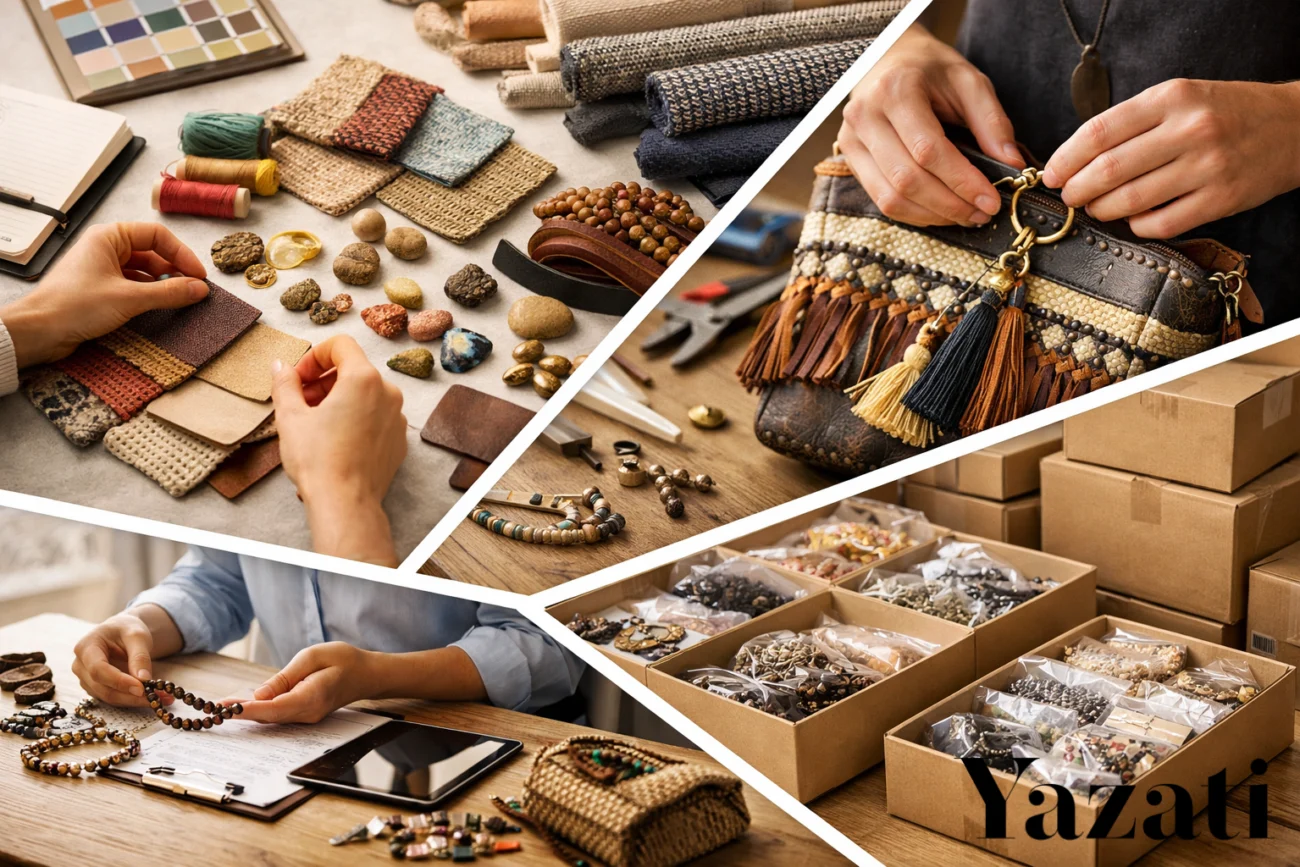
Introduction
The world of fashion accessories has evolved dramatically over the past decade. Modern customers expect products that combine multiple materials such as leather, metal, fabric, synthetic components, and decorative elements in a single accessory. These combinations create visually appealing and highly functional products—but they also introduce a significant level of manufacturing complexity.
Understanding How Yazati Handles Complex Mixed-Material Accessory Orders reveals a sophisticated system that blends design expertise, material engineering, production planning, and quality control. Mixed-material accessories—such as handbags with metal accents, wallets with fabric interiors, or belts combining leather and composite materials—require careful coordination across multiple stages of development.
Yazati has developed a streamlined operational framework to handle these demanding orders efficiently. Their approach focuses on precision planning, supplier coordination, design integration, and strict quality assurance. Each step ensures that every component—regardless of material—works together seamlessly in the final product.
Handling mixed materials is not simply about assembling different components. It involves understanding how materials behave together, how they react under different environmental conditions, and how production techniques affect durability and aesthetics.
This article explores the systems, strategies, and processes that allow Yazati to successfully manage complex accessory orders that involve multiple materials. From design development to production execution, each stage plays a critical role in delivering consistent and high-quality products.
Understanding Mixed-Material Accessories
Mixed-material accessories refer to products that incorporate two or more distinct materials within a single design. These materials may include leather, canvas, metals, plastics, synthetic fibers, rubber, or decorative components such as stones and coatings.
The purpose of combining materials is to enhance durability, visual appeal, functionality, or comfort.
Common Examples of Mixed-Material Accessories
Some common accessory types that rely on mixed materials include:
- Handbags with leather bodies and metal hardware
- Wallets combining leather exteriors and fabric linings
- Belts using leather straps with alloy buckles
- Keychains integrating metal rings and fabric loops
- Travel accessories combining synthetic and natural materials
These designs offer both style and functionality but require specialized manufacturing processes.
Challenges of Mixed-Material Production
Working with multiple materials creates several operational challenges:
- Different materials require different cutting techniques
- Material thickness and flexibility vary significantly
- Adhesives and stitching methods must be compatible
- Temperature and humidity can affect materials differently
To address these issues, Yazati implements a structured production system.
Material Selection and Compatibility Analysis
A key factor in How Yazati Handles Complex Mixed-Material Accessory Orders lies in the careful selection of compatible materials.
Before production begins, material compatibility is evaluated to ensure that components will perform well together over time.
Testing Material Behavior
Materials are tested to analyze factors such as:
- Flexibility and tensile strength
- Heat and moisture resistance
- Color stability
- Adhesion performance
For example, certain adhesives may bond well with leather but perform poorly with synthetic materials. Identifying these differences early prevents manufacturing issues later.
Balancing Aesthetics and Function
Material selection must satisfy both design goals and durability requirements.
Design teams consider factors like:
- Color harmony between materials
- Texture compatibility
- Weight balance
- Wear resistance
By aligning design creativity with engineering considerations, Yazati ensures accessories remain both attractive and durable.
Advanced Design and Prototyping Processes
Mixed-material accessories require highly detailed design planning. Even minor miscalculations in measurements or material thickness can affect assembly.
Digital Design Tools
Design teams use digital modeling tools to visualize the final product before physical production begins.
These tools help designers:
- Map the placement of different materials
- Calculate seam allowances
- Plan stitching paths
- Simulate assembly processes
This reduces production errors and improves efficiency.
Prototype Development
Once the digital model is complete, a prototype is created.
The prototype allows teams to evaluate:
- Material interaction during movement
- Comfort and usability
- Structural strength
- Visual balance
If adjustments are needed, the design is refined before mass production begins.
Supplier Coordination and Material Sourcing
Managing multiple materials requires close collaboration with reliable suppliers.
Yazati works with specialized vendors who provide high-quality materials that meet strict standards.
Supplier Evaluation Criteria
Suppliers are selected based on:
- Material consistency
- Ethical sourcing practices
- Production reliability
- Quality certifications
Each supplier must demonstrate the ability to deliver materials that meet performance and durability expectations.
Batch Consistency Control
Consistency between material batches is critical.
To maintain uniformity, Yazati implements:
- Incoming material inspections
- Color matching verification
- Thickness measurement checks
- Durability testing
These steps ensure every accessory maintains the same quality regardless of production volume.
Specialized Manufacturing Techniques
The production of mixed-material accessories requires specialized manufacturing techniques that differ from single-material products.
Precision Cutting
Each material must be cut using the appropriate method.
Examples include:
- Die cutting for leather components
- Laser cutting for synthetic fabrics
- Metal stamping for hardware pieces
Using the correct cutting method ensures clean edges and accurate dimensions.
Multi-Step Assembly Processes
Mixed-material products typically require several assembly stages.
Typical assembly steps include:
- Preparing individual material components
- Attaching linings or internal layers
- Installing hardware elements
- Final stitching and reinforcement
Each stage is carefully monitored to maintain alignment and structural integrity.
Quality Assurance and Testing
Quality control is essential when dealing with multiple materials.
Yazati follows a structured inspection process to ensure each product meets strict standards.
Pre-Production Quality Checks
Before production begins, materials are inspected for:
- Surface defects
- Color irregularities
- Structural weaknesses
Only approved materials enter the manufacturing process.
In-Process Inspections
During assembly, products are checked at multiple points to detect issues early.
Inspectors verify:
- Stitch alignment
- Hardware attachment strength
- Adhesive bonding quality
Final Product Testing
Finished accessories undergo final testing to evaluate durability and usability.
Tests may include:
- Stress testing on straps and seams
- Hardware strength verification
- Abrasion resistance testing
These evaluations confirm that the accessory can withstand everyday use.
Production Workflow Optimization
Efficient production is critical when managing complex accessory orders.
Yazati organizes manufacturing workflows to ensure smooth coordination between departments.
Production Planning
Production teams develop detailed schedules that outline:
- Material preparation timelines
- Assembly sequences
- Quality inspection checkpoints
This structured approach reduces bottlenecks and improves productivity.
Cross-Team Collaboration
Different teams must work together seamlessly.
Departments involved include:
- Design
- Material sourcing
- Production
- Quality control
Regular communication ensures that each stage supports the next.
Handling Custom and Large-Scale Orders
Mixed-material accessory orders often vary in scale and customization requirements.
Yazati has developed systems to handle both small custom runs and large production volumes.
Customization Capabilities
For custom orders, the company can adjust:
- Material combinations
- Color schemes
- Hardware finishes
- Branding elements
This flexibility allows clients to create unique products tailored to their brand identity.
Scalable Manufacturing Systems
For larger orders, production processes are optimized for efficiency without compromising quality.
Scalable systems include:
- Modular production lines
- Automated cutting equipment
- Batch processing workflows
These systems allow the company to handle complex orders at high volumes.
Sustainability in Mixed-Material Production
Sustainability has become an important consideration in accessory manufacturing.
Yazati integrates environmentally responsible practices into its production processes.
Responsible Material Use
Efforts include:
- Minimizing material waste during cutting
- Using eco-friendly alternatives when possible
- Recycling production scraps
Efficient Manufacturing Processes
Energy-efficient machinery and streamlined workflows help reduce the environmental footprint of production.
By adopting sustainable practices, the company supports both environmental responsibility and long-term manufacturing efficiency.
Benefits of Yazati’s Approach
The systems used in How Yazati Handles Complex Mixed-Material Accessory Orders provide several advantages.
Key benefits include:
- High product durability
- Consistent quality across production runs
- Efficient handling of complex designs
- Flexibility for customization
- Reliable large-scale manufacturing
These strengths make it possible to deliver sophisticated accessories that meet modern design expectations.
Frequently Asked Questions (FAQs)
1. What are mixed-material accessories?
Mixed-material accessories are products that combine two or more different materials—such as leather, fabric, metal, or synthetic components—within a single design.
2. Why are mixed-material accessories more complex to produce?
Each material requires different manufacturing methods, adhesives, stitching techniques, and handling procedures. Combining them adds multiple layers of complexity.
3. How does Yazati ensure material compatibility?
Materials are tested for flexibility, durability, heat resistance, and bonding performance before they are approved for production.
4. What role does prototyping play in accessory manufacturing?
Prototyping allows designers and engineers to test the interaction of different materials and refine the design before full-scale production begins.
5. How does Yazati maintain quality across large orders?
The company uses structured quality control systems, including material inspections, in-process monitoring, and final product testing.
6. Can mixed-material accessories be customized for different brands?
Yes. Manufacturers can adjust materials, colors, hardware, and branding elements to create unique products tailored to specific client requirements.
Conclusion
Mixed-material accessories represent a sophisticated segment of the fashion industry, where creativity meets engineering precision. Successfully managing these products requires careful coordination across design, material sourcing, production, and quality assurance.
Understanding How Yazati Handles Complex Mixed-Material Accessory Orders highlights the importance of structured processes, advanced technology, and skilled craftsmanship. From compatibility testing and digital design modeling to specialized manufacturing techniques and strict quality control, each stage contributes to a reliable and efficient production system.
By integrating these strategies, Yazati ensures that even the most intricate accessory designs are produced with consistency, durability, and visual excellence. This comprehensive approach allows the company to meet the evolving demands of modern fashion markets while maintaining high standards of craftsmanship and operational efficiency.
✨ Discover Global Sourcing Excellence with Netyex ✨
Netyex is your trusted B2B sourcing partner, connecting international buyers with India’s finest manufacturers and curated product lines—from handicrafts and home décor to kitchenware, textiles, hospitality essentials, and more. With verified suppliers and end-to-end support, we make global procurement seamless, reliable, and efficient.
👉 Elevate your sourcing experience—explore Netyex today.
📦 Bulk orders & customisation | 🌍 Worldwide delivery | 🤝 Trusted by global buyers
Visit Netyex to source premium Indian products with confidence.