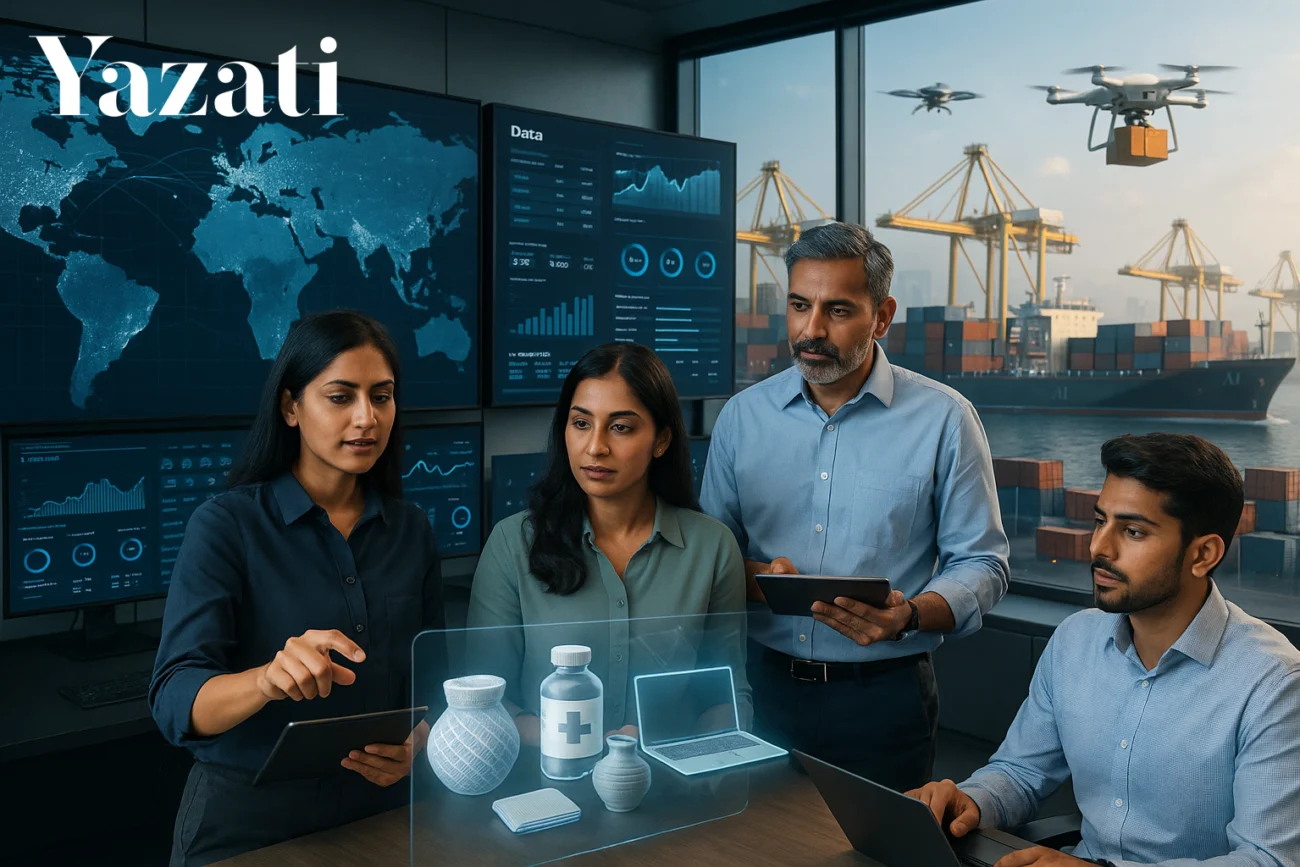
Introduction: India’s Export Landscape in a Digital Age
India stands at the threshold of a transformative era where technology, digital trade, and artificial intelligence (AI) are reshaping the global export landscape. With an ambitious vision to reach $2 trillion in exports by 2030, India’s journey is being redefined by digitalization, innovation, and automation.
From AI-driven logistics to digital payment infrastructures like UPI and ONDC, India is no longer just a participant in global trade — it’s becoming a trailblazer in smart exports. The convergence of AI with trade policies, market intelligence, and production efficiency promises to elevate India’s global competitiveness.
Understanding Digital Trade and Its Impact on Global Commerce
Definition and Scope of Digital Trade
Digital trade refers to the exchange of goods and services that are digitally ordered, delivered, or supported. This includes everything from cross-border e-commerce to digital financial services, AI-based logistics, and intellectual property-driven exports.
In simple terms, digital trade allows Indian businesses — especially small and medium enterprises (MSMEs) — to access global customers without traditional intermediaries.
Role of E-commerce and Digital Platforms in Exports
The rise of e-commerce platforms like Amazon Global, Flipkart Export Hub, and Alibaba has opened international markets to Indian artisans, manufacturers, and startups. Digital platforms simplify compliance, automate documentation, and integrate payment systems — all critical to export success.
India’s ONDC (Open Network for Digital Commerce) is further democratizing access to markets, ensuring even micro-entrepreneurs can export digitally with minimal costs.
India’s Current Export Ecosystem: Opportunities and Challenges
Traditional Export Sectors and Their Transformation
India’s export backbone — textiles, pharmaceuticals, and engineering goods — is now merging with AI to optimize efficiency. For instance, AI-enabled quality checks in textile manufacturing or predictive analytics in pharma exports are reducing errors and improving delivery timelines.
Bottlenecks: Infrastructure, Policy, and Skill Gaps
Despite growth, challenges persist. Digital infrastructure in rural areas, complex export documentation, and limited AI literacy among exporters hinder adoption. Bridging these gaps through targeted government reforms and public-private partnerships will be key.
The Role of Artificial Intelligence in Revolutionizing Exports
AI-Powered Supply Chain Optimization
AI enhances real-time visibility across global supply chains. It predicts bottlenecks, optimizes routes, and minimizes waste — vital for perishable or high-value exports. For example, AI algorithms help exporters track shipments and forecast customs clearance times, ensuring better efficiency.
Predictive Analytics and Demand Forecasting
By analyzing millions of data points, AI helps exporters anticipate demand fluctuations. Indian exporters can now adapt production based on seasonal trends, global trade data, and consumer sentiment. This agility is reshaping competitiveness.
Smart Manufacturing and Product Customization
Smart factories powered by AI and IoT allow Indian exporters to customize products for global markets. Sectors like automotive, precision tools, and electronics are increasingly adopting this model, making “Made in India” synonymous with “Digitally Smart.”
Digital Trade Platforms Empowering Indian MSMEs
How Startups Are Driving Export Digitization
Startups like Shiprocket, Moglix, and Zetwerk are revolutionizing exports through AI-driven logistics, digital invoicing, and global supplier networks. Their technology-first approach reduces costs and increases reach for thousands of small exporters.
Case Studies: Successful AI Adoption Stories in Export Businesses
One success story is Zetwerk, which uses AI to manage manufacturing contracts for global clients. By predicting order fulfillment risks and automating quality control, Zetwerk increased export efficiency by over 30%.
India’s Digital Public Infrastructure: A Global Model
UPI, ONDC, and Aadhaar in Export Facilitation
India’s Digital Public Infrastructure (DPI) — comprising UPI, Aadhaar, and ONDC — has set a benchmark for transparency and scalability. These systems make cross-border payments seamless and enable easy verification of exporters.
Integration with Global Digital Trade Networks
Collaborations between India and international digital trade frameworks (like the EU’s Digital Trade Principles) ensure interoperability and foster trust across borders.
Policy Reforms and Government Initiatives for Digital Exports
Foreign Trade Policy 2023 and Vision 2047
The Foreign Trade Policy (FTP) 2023 focuses on “Amrit Kaal of Indian Exports,” prioritizing digitalization and AI-driven trade facilitation. Its long-term goal is to establish India as a global hub for digital exports.
Incentives for AI-Driven Export Solutions
Government schemes such as Digital India, Startup India, and India AI Mission support exporters adopting automation, machine learning, and data analytics.
Emerging Export Sectors Powered by AI and Data Analytics
IT Services, Fintech, and Digital Goods
India’s IT sector has long been a global powerhouse, but the future lies in AI-driven digital exports. Services such as cloud computing, AI consulting, blockchain solutions, and fintech innovations are becoming key export categories.
The country’s fintech exports, particularly digital payment solutions like UPI, are being adopted by nations such as Singapore and the UAE. Similarly, Indian startups are now exporting AI models, SaaS products, and cybersecurity tools to international clients.
According to NASSCOM, India’s digital export potential could exceed $350 billion by 2030, driven by innovation in AI and data analytics.
Green Technologies and Smart Manufacturing
As the world transitions to sustainable production, India is emerging as a leader in green technology exports. AI supports energy-efficient manufacturing, predictive maintenance, and carbon footprint tracking, helping Indian industries meet international environmental standards.
Companies in solar energy, electric vehicles, and waste management are using digital twins and AI algorithms to optimize their export performance. This positions India as both a climate-conscious and tech-forward exporter.
Cross-Border Data Flows and Cybersecurity in Digital Trade
Data Localization vs. Global Accessibility
One of the biggest debates in digital trade is about data sovereignty — the balance between protecting local data and ensuring global interoperability. India’s Digital Personal Data Protection Act (DPDP) outlines how data can move securely across borders while maintaining privacy.
Exporters must navigate compliance carefully, ensuring that AI models trained on global datasets do not violate local data laws.
Ensuring Trust and Transparency in AI-Driven Trade
Trust is at the core of digital trade. For exporters using AI, maintaining transparency about data sources, algorithmic decisions, and trade documentation is vital. Blockchain technology, combined with AI, ensures traceability and authenticity — building confidence among foreign buyers.
The Role of Education and Skill Development in AI-Enabled Exports
Digital Upskilling for Export Workforce
India’s export future depends not just on machines but on people who can operate them intelligently. Programs like Skill India Digital, AI for Youth, and FutureSkills Prime are preparing the workforce to handle AI tools, data analytics, and export technologies.
This transition from manual export management to AI-assisted decision-making is vital for scalability.
Collaboration Between Academia and Industry
Collaborations between top universities, research institutions, and export bodies are driving innovation. For instance, IITs are partnering with NASSCOM to develop AI models specific to export forecasting and logistics optimization.
Future Outlook: India’s Position in the Global Digital Trade Ecosystem
Predictions for 2030 and Beyond
By 2030, India is projected to become one of the top five global exporters powered by AI-driven trade systems. The integration of digital identities, smart logistics, and blockchain-based documentation will make exporting faster, safer, and more inclusive.
Key predictions include:
- Over 70% of export documentation becoming fully automated.
- MSMEs contributing half of all digital exports.
- AI enhancing India’s export value by an additional $500 billion through efficiency gains.
Key Takeaways for Businesses and Policymakers
Businesses should prioritize AI adoption, digital compliance, and sustainability, while policymakers must strengthen data-sharing frameworks and global trade partnerships. Together, these will cement India’s leadership in the new digital trade era.
FAQs on The Future of Indian Exports: Digital Trade & AI Integration
1. What is digital trade, and how does it benefit Indian exporters?
Digital trade refers to the online exchange of goods, services, and data. It allows Indian exporters to reach global buyers, reduce transaction costs, and increase efficiency through automation.
2. How is AI transforming India’s export sector?
AI is enhancing supply chain management, predictive analytics, and quality control, making exports more efficient, reliable, and globally competitive.
3. Which sectors will benefit the most from digital trade and AI integration?
Sectors like IT services, e-commerce, manufacturing, agriculture, and renewable energy are seeing the greatest benefits from AI integration.
4. How are Indian MSMEs adapting to digital exports?
With platforms like ONDC, Shiprocket, and Amazon Global Selling, MSMEs can export products digitally with simplified logistics and automated documentation.
5. What are the government’s major initiatives supporting digital trade?
Initiatives such as Digital India, Foreign Trade Policy 2023, and India AI Mission promote innovation, digital infrastructure, and AI adoption across export sectors.
6. How can exporters ensure cybersecurity and data protection in digital trade?
By following data localization laws, implementing AI ethics standards, and using blockchain verification, exporters can ensure data integrity and build trust globally.
Conclusion: Paving the Way for Smart, Sustainable, and Inclusive Export Growth
The future of Indian exports lies at the intersection of digital transformation and AI-driven innovation. As India continues to embrace smart logistics, digital finance, and intelligent supply chains, it is poised to redefine global trade dynamics.
By 2030, AI will not just optimize exports—it will empower exporters, creating a more inclusive, sustainable, and tech-savvy economy.
India’s vision for a digitally empowered export ecosystem aligns perfectly with its aspiration to be a global economic leader in the 21st century.
For exporters, policymakers, and entrepreneurs alike, the message is clear: embrace digital trade, harness AI, and lead the world in intelligent exports.
✨ Discover Global Sourcing Excellence with Netyex ✨
Netyex is your trusted B2B sourcing partner, connecting international buyers with India’s finest manufacturers and curated product lines—from handicrafts and home décor to kitchenware, textiles, hospitality essentials, and more. With verified suppliers and end-to-end support, we make global procurement seamless, reliable, and efficient.
👉 Elevate your sourcing experience—explore Netyex today.
📦 Bulk orders & customisation | 🌍 Worldwide delivery | 🤝 Trusted by global buyers
Visit Netyex to source premium Indian products with confidence.