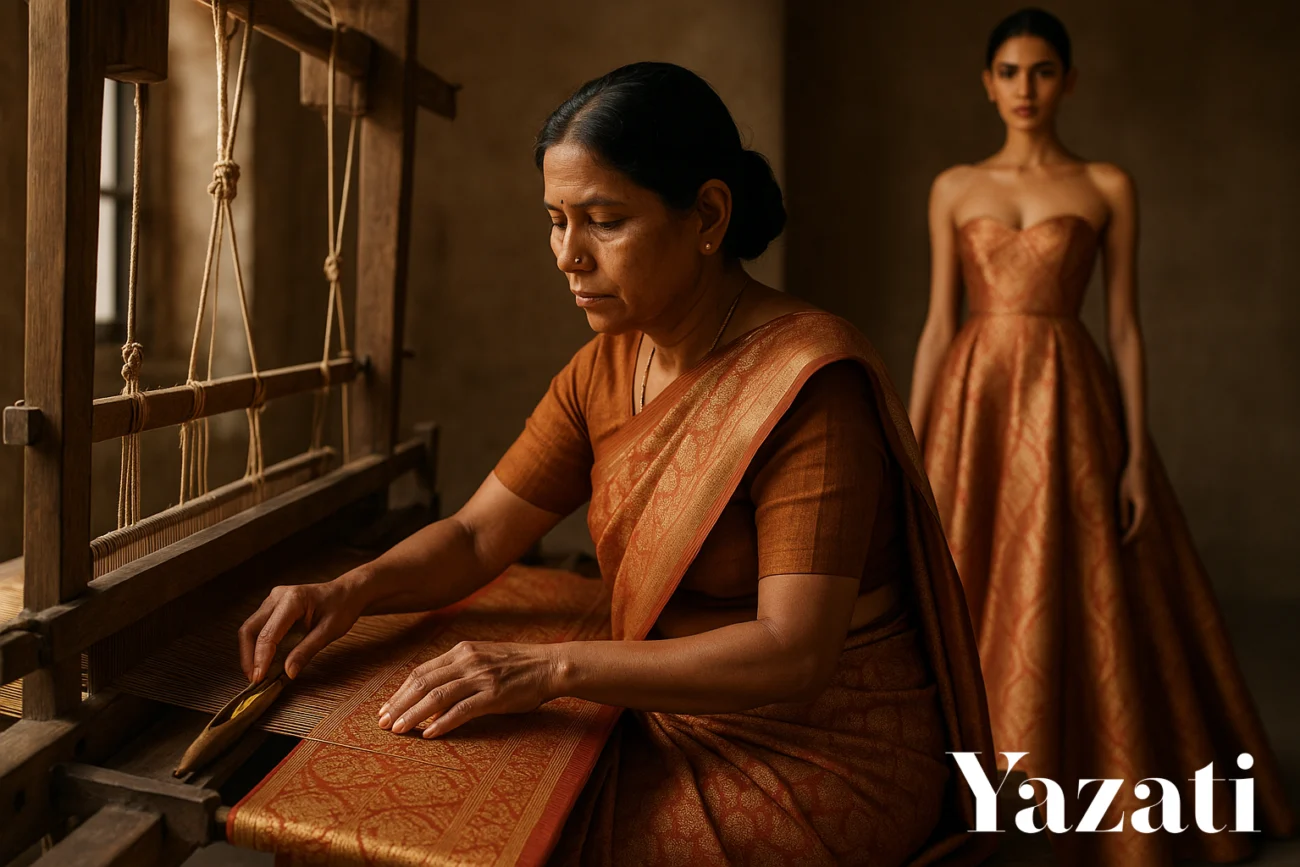
Introduction – The Legacy of Indian Weaves
The phrase “woven with love” takes on a whole new meaning when it comes to Indian handlooms. For centuries, the threads spun on wooden looms across the subcontinent have not only clothed generations but also told stories of culture, identity, and craftsmanship. The power of Indian weaves lies in their blend of artistry, sustainability, and timeless beauty — a heritage that has gracefully transitioned from rural looms to global haute couture runways.
Each region in India contributes a unique fabric tradition, shaped by local climate, culture, and creativity. Whether it’s the shimmering Banarasi silk, the delicate Chanderi cotton, or the bold patterns of Ikat, every weave reflects the soul of its people. Today, as the world shifts toward sustainable and ethical fashion, Indian handlooms are making a remarkable comeback, celebrated for their authenticity and craftsmanship.
The Origins of Indian Weaving Tradition
The story of Indian weaving begins thousands of years ago, tracing back to the Indus Valley Civilization. Archaeological discoveries of spindles and dyed cotton threads suggest that India was among the first to master textile creation. Ancient scripts like the Rigveda and records from travelers such as Megasthenes and Marco Polo praise the fineness of Indian fabrics.
Over centuries, weaving evolved under the patronage of kings and queens. Mughal emperors popularized rich brocades like Banarasi silk, while South Indian dynasties nurtured the tradition of Kanchipuram silk sarees, known for their lustrous finish and intricate borders. Each region infused its artistic DNA into the fabric, making Indian textiles a kaleidoscope of colors and motifs.
The Diversity of Indian Weaves
India’s geographical and cultural diversity finds its purest expression in its textiles.
- North India: The regal Banarasi silk from Varanasi dazzles with gold zari, while Chanderi and Maheshwari cottons from Madhya Pradesh exude elegance.
- South India: Kanchipuram silk is synonymous with opulence, and Pochampally Ikat showcases mathematical precision in its patterns.
- Eastern India: Baluchari sarees from Bengal narrate mythological tales through motifs, while Assam’s Muga and Eri silks are prized for their natural sheen and durability.
- Western India: Patola from Gujarat and Bandhani from Rajasthan highlight the vivid hues and resist-dyeing expertise of the region.
Each weave is a living tradition — a masterpiece passed down from generation to generation.
The Craftsmanship Behind the Loom
Behind every exquisite weave lies an artisan’s devotion. Handloom weaving is a slow, intricate process involving precise coordination of hands, feet, and imagination. From spinning natural fibers to dyeing with organic pigments, each step demands skill and patience.
Traditional looms, often made of wood, require synchronization of warp and weft threads — a mesmerizing dance of color and texture. The weaver’s touch adds individuality to each piece, making no two fabrics identical.
Furthermore, India’s handlooms are eco-friendly by nature, consuming minimal energy and relying on natural dyes like indigo, turmeric, and madder root. In today’s era of fast fashion, these weaves represent conscious craftsmanship.
Weaving Communities and Their Socioeconomic Role
The handloom sector is not just about aesthetics; it sustains millions of families across India. Weaving clusters in states like Tamil Nadu, Assam, and Uttar Pradesh form the backbone of rural economies. Women, in particular, play a pivotal role — balancing domestic life with their artistry.
However, the journey hasn’t been easy. Powerloom competition, lack of fair wages, and limited market access have challenged traditional weavers. Thankfully, organizations and NGOs are helping artisans find their footing again through cooperative models and global exposure.
Evolution from Handloom to Powerloom
With industrialization came the rise of powerlooms, which increased output but compromised craftsmanship. While machine-made textiles made fashion accessible, they also threatened the livelihood of handloom weavers.
Today, however, both coexist — the handloom serving as a symbol of heritage, while the powerloom caters to mass production. The revival movement has redefined handloom as luxury craft, not outdated tradition.
Revival of Indian Weaves in Modern Fashion
Designers like Sabyasachi Mukherjee, Ritu Kumar, and Gaurang Shah have elevated Indian weaves to the global stage. Their collections celebrate traditional textiles through contemporary silhouettes, bridging the gap between past and present.
From Sonam Kapoor in handwoven saris on the red carpet to Priyanka Chopra’s fusion ensembles, Indian weaves have become synonymous with elegance and identity.
Indian Weaves in Haute Couture
Luxury fashion houses now recognize the uniqueness of handwoven fabrics. Indian motifs, mirror work, and embroidery have influenced global couture collections. The slow fashion movement has made handcrafted fabrics desirable again, not just for their beauty but for their sustainability.
Designers like Rahul Mishra, who presented handwoven pieces at Paris Fashion Week, have shown that Indian craftsmanship belongs to the global luxury space.
Government and NGO Initiatives Supporting Handlooms
Recognizing the immense cultural and economic value of the handloom sector, the Government of India has implemented several programs to preserve and promote this traditional art form.
National Handloom Development Programme (NHDP)
This initiative focuses on enhancing the competitiveness of handloom products, providing financial assistance, and modernizing looms while maintaining the authenticity of craftsmanship.
Handloom Mark and India Handloom Brand
To protect consumers and artisans alike, the Handloom Mark certifies authenticity — ensuring the fabric is genuinely handwoven. The India Handloom Brand goes a step further by promoting high-quality products that reflect the pride of Indian heritage.
Campaigns like “Make in India” and “Vocal for Local”
Under these initiatives, Indian textiles are being positioned as luxury products with global appeal. Fashion events, exhibitions, and collaborations have given artisans international exposure.
NGOs and Social Enterprises
Organizations like Dastkar, Fabindia, and Crafts Council of India connect rural weavers directly to urban and global markets. Their initiatives ensure fair wages, sustainable practices, and continuous skill development — breathing new life into age-old traditions.
The Sustainable and Ethical Edge of Handwoven Fabrics
In today’s age of eco-conscious consumers, Indian handlooms stand as a shining example of sustainability. Unlike powerlooms that consume electricity and synthetic dyes, handlooms rely on natural fibers and renewable energy sources.
Environmental Benefits
Handwoven textiles reduce carbon footprints by using minimal machinery and natural dyes. Fabrics like organic cotton, khadi, and peace silk are biodegradable and skin-friendly.
Ethical Employment
Each piece of handloom fabric represents dignified labor — every thread supporting livelihoods in rural communities. Consumers today aren’t just buying cloth; they’re investing in people, stories, and purpose.
Slow Fashion Movement
As the world moves away from disposable fashion, Indian weaves align perfectly with the slow fashion philosophy — quality over quantity, heritage over trends. The result? Timeless elegance that respects both artisans and the environment.
Digitalization and E-commerce Revolutionizing Indian Weaves
The digital era has woven new opportunities for Indian artisans.
Online Marketplaces
Platforms like GoCoop, Jaypore, and Okhai have democratized access to handloom products. Artisans who once sold locally now reach global customers directly through e-commerce.
Social Media Storytelling
Instagram and YouTube have become virtual galleries where weavers showcase their creations and share behind-the-scenes stories. This transparency fosters deeper appreciation and builds emotional connections with buyers.
Virtual Exhibitions
During the pandemic, digital exhibitions and online fashion weeks kept the spotlight on Indian craftsmanship, ensuring continuity even in challenging times.
By merging tradition with technology, Indian weaves are now thriving in a global digital ecosystem.
The Role of Indian Weaves in Global Identity
Indian weaves have transcended borders to become ambassadors of culture and identity. From the red carpets of Cannes to runways in Milan and Paris, Indian textiles are celebrated for their intricacy and soul.
Designers worldwide are embracing Indian fabrics for their authenticity and depth. International celebrities like Naomi Campbell, Emma Watson, and Gigi Hadid have donned Indian-inspired creations, signaling a new era of global admiration.
Beyond fashion, Indian weaves serve as soft power diplomacy, promoting India’s rich cultural heritage on global platforms like UNESCO and World Handloom Day celebrations.
Preserving the Craft for Future Generations
Preserving India’s weaving traditions requires both innovation and education.
Skill Development Programs
Government and private institutions have introduced training centers to teach younger generations the art of weaving, dyeing, and fabric design.
Cultural Documentation
Organizations are now archiving patterns, motifs, and weaving methods digitally — ensuring that traditional knowledge isn’t lost.
Incorporating Weaving in Modern Curriculums
Fashion schools like NIFT and Pearl Academy have included handloom studies in their programs, bridging the gap between design innovation and heritage preservation.
By empowering the youth with traditional skills, India ensures that its weaving legacy remains alive for centuries to come.
Expert Tips on Buying Authentic Handwoven Fabrics
Buying authentic Indian handlooms requires a discerning eye. Here’s how you can ensure your purchase supports genuine craftsmanship:
- Look for the Handloom Mark: This government-certified logo guarantees authenticity.
- Feel the Texture: Handwoven fabrics often have minor irregularities — a hallmark of handmade beauty.
- Ask About Origin: Genuine sellers will proudly mention the weaving cluster (e.g., Banaras, Kanchipuram, or Bhagalpur).
- Support Verified Artisans: Purchase directly from certified weavers, cooperatives, or trusted online platforms.
- Understand the Weave: Each region’s textile has unique features — familiarize yourself with patterns, motifs, and weaving techniques.
- Choose Sustainable Brands: Opt for brands committed to fair trade and eco-friendly practices.
When you buy authentic, you don’t just wear a piece of fabric — you wear history.
FAQs – Everything You Need to Know About Indian Weaves
Q1. What makes Indian weaves unique compared to other textiles?
Indian weaves are entirely handmade, using centuries-old techniques that reflect regional identity and natural craftsmanship — no two pieces are ever identical.
Q2. Are handwoven fabrics sustainable?
Yes, handloom fabrics are inherently sustainable, using minimal energy, natural dyes, and biodegradable materials.
Q3. How can I tell if a fabric is handwoven or machine-made?
Look for slight irregularities in the weave, uneven selvedges, and the presence of the Handloom Mark for authenticity.
Q4. Which Indian weaves are most famous globally?
Banarasi silk, Kanchipuram silk, Jamdani, Pochampally Ikat, and Patola are among the most admired worldwide.
Q5. What is the significance of handloom day in India?
National Handloom Day (August 7) celebrates India’s weaving heritage and honors the contribution of artisans to the economy and culture.
Q6. How can consumers support traditional weavers?
Buy directly from artisan cooperatives, promote ethical brands, and educate others about the value of handcrafted fabrics.
Conclusion – Weaving the Threads of Heritage and Modernity
The power of Indian weaves lies in their ability to connect past and present — tradition and innovation, simplicity and sophistication. From humble handlooms in village homes to dazzling haute couture runways, these fabrics embody resilience, creativity, and cultural pride.
As the fashion world embraces sustainability, Indian weaves are not just making a comeback — they’re shaping the future. Every thread tells a story, every motif carries meaning, and every saree, stole, or garment becomes a living legacy.
So, the next time you drape an Indian handloom, remember — you’re not just wearing art; you’re wearing history, humanity, and hope.
✨ Discover Global Sourcing Excellence with Netyex ✨
Netyex is your trusted B2B sourcing partner, connecting international buyers with India’s finest manufacturers and curated product lines—from handicrafts and home décor to kitchenware, textiles, hospitality essentials, and more. With verified suppliers and end-to-end support, we make global procurement seamless, reliable, and efficient.
👉 Elevate your sourcing experience—explore Netyex today.
📦 Bulk orders & customisation | 🌍 Worldwide delivery | 🤝 Trusted by global buyers
Visit Netyex to source premium Indian products with confidence.