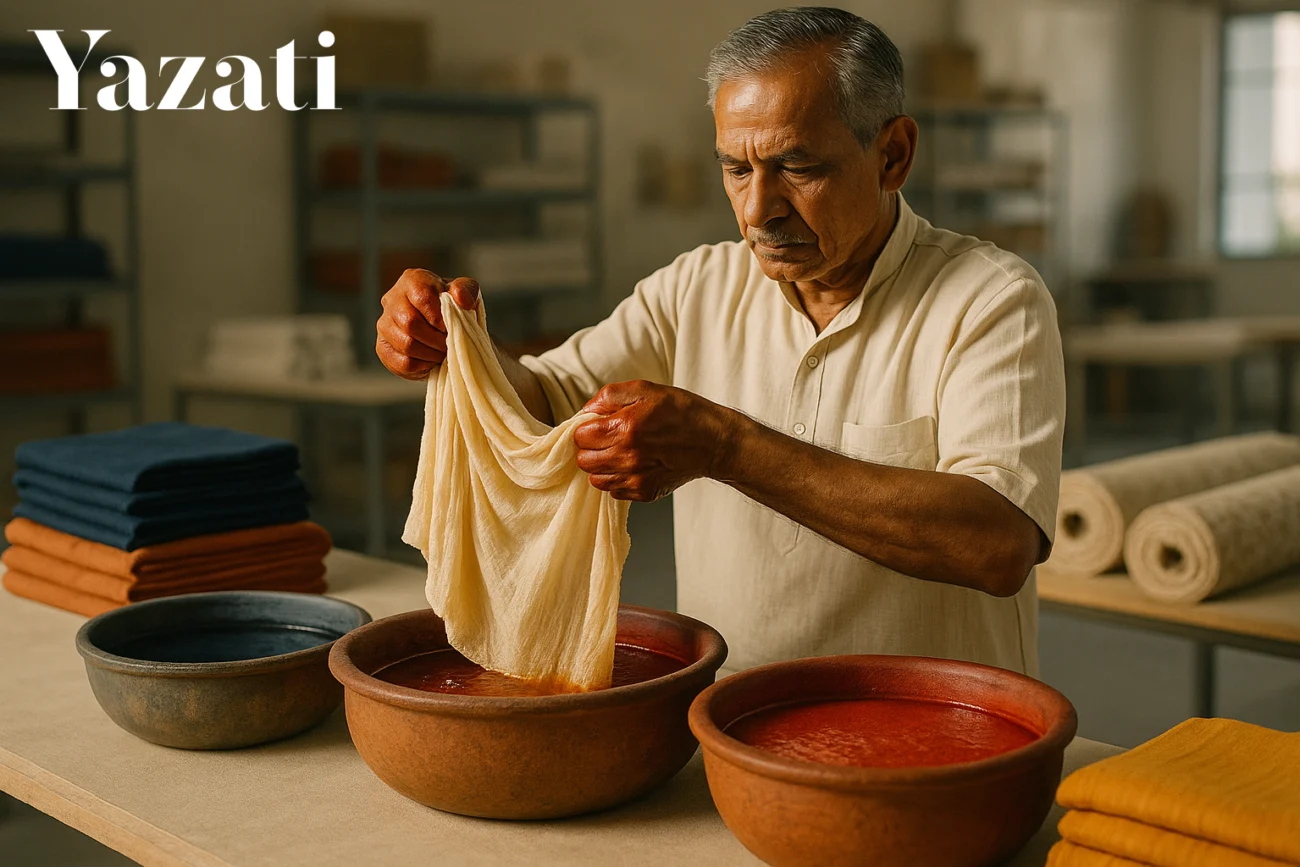
Introduction: The Colorful Legacy of Indian Textiles
India’s relationship with color, cloth, and creativity stretches back over five millennia. From the ochre-dyed cottons unearthed in the Indus Valley to today’s sustainable silk exports, the story of Indian dyeing traditions and modern textile exports is one of artistry, resilience, and reinvention.
For centuries, Indian textiles have captivated the world. Traders from Egypt, China, Rome, and later Europe marveled at India’s mastery in natural dyes — particularly the deep blue of indigo and the fiery red of madder. These colors weren’t just aesthetic choices; they were symbols of identity, spirituality, and cultural pride.
As the modern textile industry evolves with technology and sustainability, India continues to blend ancient wisdom with cutting-edge innovation, making it a global leader in textile exports.
Ancient Origins: India’s Role in the Global Dyeing Heritage
Early Dyeing Techniques in the Indus Valley Civilization
Archaeological evidence from sites like Mohenjo-Daro and Harappa reveals that ancient Indians were among the earliest practitioners of textile dyeing. Fragments of cotton fabrics, dyed with natural pigments, date back to around 2500 BCE.
These early artisans used minerals, bark, and roots to produce a vivid palette of colors — each carefully prepared through eco-friendly processes that required no synthetic chemicals.
The Influence of Natural Dyes: Indigo, Madder, and Turmeric
Three natural dyes dominated ancient Indian color-making:
- Indigo: Cultivated primarily in Bihar and Bengal, this deep blue pigment became India’s most famous export.
- Madder: A root producing brilliant reds and oranges, widely used in Gujarat and Rajasthan.
- Turmeric: Revered for its golden hue and antiseptic qualities, turmeric was used both for fabric dyeing and ceremonial rituals.
Together, these dyes painted the story of India’s craftsmanship and commerce.
The Art of Natural Dyeing: Techniques and Regional Styles
Bandhani and Tie-Dye Traditions of Gujarat and Rajasthan
Bandhani, or tie-dyeing, involves binding small sections of cloth with thread before dyeing. When the fabric is unfolded, intricate dotted patterns emerge — symbols of prosperity and festivity.
Each color holds cultural significance: red for marriage, yellow for motherhood, and green for fertility.
Kalamkari: The Painted Fabrics of Andhra Pradesh
Derived from the Persian words kalam (pen) and kari (work), Kalamkari is an ancient hand-painting technique that uses natural dyes and fine detailing. The motifs often depict Hindu epics like the Mahabharata and Ramayana, turning each fabric into a canvas of storytelling.
Ikat Weaving and Resist Dyeing in Odisha and Telangana
Ikat involves dyeing the yarn before weaving, creating a mesmerizing blur effect. The technique showcases mathematical precision and artistic flair — evidence of India’s scientific understanding of color absorption and resist dyeing.
The Symbolism of Color in Indian Culture and Textiles
Colors in Indian textiles aren’t random — they’re deeply symbolic expressions of philosophy, spirituality, and emotion.
- Red represents fertility and marital bliss.
- Yellow symbolizes learning and sanctity.
- Blue, derived from indigo, stands for bravery and divine protection.
- White, though symbolizing purity, is also linked to mourning in Indian traditions.
Each dyed fabric thus tells not only a story of craftsmanship but of cultural identity and belonging.
Colonial Era Transformations: Decline and Resistance
British Trade Monopolies and the Fall of Indigenous Dyeing
The arrival of the British East India Company in the 17th century drastically altered India’s textile landscape.
Mass-produced British textiles, coupled with trade restrictions, led to the decline of India’s indigenous dyeing and weaving industries.
The introduction of synthetic dyes in the 19th century further marginalized traditional artisans, replacing natural processes with industrial production.
Revival through the Swadeshi Movement and Gandhi’s Khadi
During the freedom struggle, Mahatma Gandhi resurrected India’s textile pride through Khadi — hand-spun and hand-dyed cotton symbolizing self-reliance.
Khadi wasn’t just fabric; it became a political statement of resistance against colonial oppression and an emblem of national identity.
Post-Independence Revival: Blending Heritage with Modernity
Government and NGO Initiatives to Protect Handicrafts
Post-1947, India began reclaiming its textile heritage. The All India Handicrafts Board and Khadi and Village Industries Commission were established to preserve traditional dyeing and weaving methods.
Artisans and Sustainable Textile Clusters Across India
Regions like Kutch, Varanasi, and Bhuj emerged as sustainable textile hubs, where artisans use natural dyes and eco-friendly production to cater to global markets seeking ethical fashion.
The Global Rise of Indian Textiles in the Modern Era
From Handlooms to Haute Couture: India’s Global Textile Presence
Today, Indian textiles are showcased in global fashion weeks, adorning runways from Paris to New York. Designers like Anita Dongre, Rahul Mishra, and Sabyasachi have integrated traditional dyeing methods into modern couture.
Export Statistics and India’s Major Textile Hubs
India currently ranks among the top three textile exporters globally, contributing around 12% of global textile trade.
Key hubs include Tirupur, Surat, Panipat, and Bhilwara, each specializing in distinct segments — from knitwear to home textiles.
Sustainability and Eco-Friendly Dyeing in the 21st Century
As environmental awareness grows worldwide, India’s ancient knowledge of natural dyeing has found new relevance. Today’s textile innovators are blending ancestral techniques with modern science to create sustainable, non-toxic fabrics that appeal to eco-conscious consumers.
Natural vs. Synthetic Dyes: Environmental Impacts
Synthetic dyes, though economical and diverse in color range, come at a high environmental cost. They release toxic effluents into water systems and harm both ecosystems and human health. In contrast, natural dyes — made from plants, minerals, and insects — are biodegradable and non-polluting.
Artisans across India are returning to organic sources such as:
- Indigo leaves for blue
- Madder roots for red
- Harda fruit for yellow
- Pomegranate rind for green tones
The global demand for eco-friendly and chemical-free textiles has breathed new life into these practices, especially among small-scale artisans and ethical fashion brands.
Innovations in Organic and Plant-Based Dyeing
Recent innovations combine biotechnology and traditional dyeing. Indian startups are experimenting with microbial dyes, algae-based pigments, and waste-free dye baths that drastically reduce water usage.
For example, “Biodye India” has developed patented techniques for producing colorfast, eco-friendly dyes derived from plants. Similarly, social enterprises like Fabindia and Dastkar support artisan clusters that practice environmentally responsible dyeing.
This revival is not just about color — it’s about reviving livelihoods, preserving biodiversity, and promoting sustainability.
The Role of Technology and Innovation in Textile Exports
The fusion of tradition and technology has transformed India’s textile industry into a digitally driven global powerhouse.
Digital Printing and Smart Textiles
Digital textile printing allows intricate traditional patterns — like Kalamkari, Ajrakh, and Ikat — to be replicated with precision and minimal waste.
Moreover, smart textiles, which integrate sensors or responsive materials, are positioning India as a player in the technical and performance fabric segment — from sportswear to healthcare applications.
AI, Automation, and the Future of Indian Textile Manufacturing
Artificial Intelligence (AI) and automation are revolutionizing how Indian textile companies operate.
AI algorithms now:
- Predict color trends and fabric demand
- Optimize dye recipes for sustainability
- Improve quality control through computer vision systems
Automation has improved consistency, while blockchain technology ensures transparency in sourcing, giving international buyers confidence in ethical and sustainable supply chains.
Major Export Markets and India’s Competitive Advantage
Key Export Destinations: USA, EU, and Emerging Markets
India exports textiles to over 150 countries, with major destinations including:
- United States (cotton apparel and home textiles)
- European Union (fashion and technical fabrics)
- Middle East and Japan (premium silk and embroidered textiles)
Emerging markets in Africa and Latin America are also showing increased demand for Indian-made fabrics due to their quality and price competitiveness.
Trade Agreements and the Growth of India’s Textile Economy
India’s trade agreements under FTA (Free Trade Agreements) and GSP (Generalized System of Preferences) schemes have bolstered textile exports.
Government policies such as the Production Linked Incentive (PLI) Scheme and Integrated Textile Parks initiative further strengthen India’s global presence.
The country’s diverse raw material base — from cotton and jute to silk and synthetic fibers — gives it an unparalleled edge in the global textile market.
Challenges in the Modern Textile Export Industry
Despite its successes, the Indian textile industry faces significant challenges in maintaining global competitiveness.
Labor, Sustainability, and Global Competition
Labor costs in India are rising, and artisans face competition from low-cost producers like Bangladesh and Vietnam. Additionally, global buyers increasingly demand sustainable certifications, which smaller producers struggle to afford.
To stay competitive, Indian textile firms are focusing on:
- Skill development programs
- Sustainable certifications (like GOTS and OEKO-TEX)
- Innovation in materials and eco-friendly practices
The Shift Toward Ethical and Transparent Supply Chains
Consumers today want to know who made their clothes. This has led to a growing emphasis on traceability and transparency in textile supply chains.
India’s traditional clusters are adopting blockchain and digital tracking systems to verify authenticity and fair labor practices — bridging ancient art with 21st-century accountability.
The Future of Indian Dyeing and Textile Exports
Reviving Ancient Techniques for Modern Consumers
The revival of India’s ancient dyeing methods is more than nostalgia — it’s a sustainable solution for the future. Natural dyes, once marginalized, are now seen as luxury markers in global fashion. Brands like Anokhi, Raw Mango, and Good Earth showcase how ancient crafts can thrive in the modern marketplace.
The Role of Young Designers and Sustainable Brands
India’s new generation of designers is redefining what “Made in India” means.
They’re merging handcrafted dyeing traditions with modern silhouettes, emphasizing sustainability, gender neutrality, and slow fashion.
International collaborations, digital marketplaces, and eco-certifications are helping them reach global audiences who value authenticity and sustainability.
The future looks bright — quite literally — for India’s colorful textile legacy.
Frequently Asked Questions (FAQs)
1. What are the oldest known dyeing traditions in India?
India’s oldest dyeing traditions date back to the Indus Valley Civilization (2500 BCE), where natural dyes made from plants, roots, and minerals were used to color cotton fabrics.
2. Why was indigo dye so important in India’s history?
Indigo was one of India’s most valuable exports, prized for its deep blue color and durability. It became a major colonial trade commodity and even influenced global art and fashion.
3. How does India balance traditional dyeing with modern textile exports?
India integrates traditional dyeing into sustainable, high-quality exports, combining handloom craftsmanship with modern technology, ensuring global appeal and eco-friendliness.
4. Are natural dyes still used in India today?
Yes. Natural dyes are witnessing a resurgence due to growing demand for sustainable fashion. Many artisan clusters now specialize in organic and plant-based dyes.
5. What are India’s main textile export products?
India exports cotton garments, silk fabrics, home textiles, technical textiles, and increasingly, sustainably dyed fabrics to markets in the USA, Europe, and Asia.
6. How is India promoting sustainability in its textile sector?
The government and private sector promote eco-friendly dyeing, zero-waste production, and green certifications to align with international environmental standards.
Conclusion: Weaving the Past into the Future
The story of Indian dyeing traditions and modern textile exports is more than a tale of color and cloth — it’s a saga of resilience, innovation, and global evolution.
From the indigo vats of ancient artisans to AI-driven textile factories, India continues to weave its identity into the fabric of the world.
As the world turns toward ethical, sustainable, and culturally rich products, India’s textile heritage shines brighter than ever — proving that the hues of history can indeed color the future.
✨ Discover Global Sourcing Excellence with Netyex ✨
Netyex is your trusted B2B sourcing partner, connecting international buyers with India’s finest manufacturers and curated product lines—from handicrafts and home décor to kitchenware, textiles, hospitality essentials, and more. With verified suppliers and end-to-end support, we make global procurement seamless, reliable, and efficient.
👉 Elevate your sourcing experience—explore Netyex today.
📦 Bulk orders & customisation | 🌍 Worldwide delivery | 🤝 Trusted by global buyers
Visit Netyex to source premium Indian products with confidence.