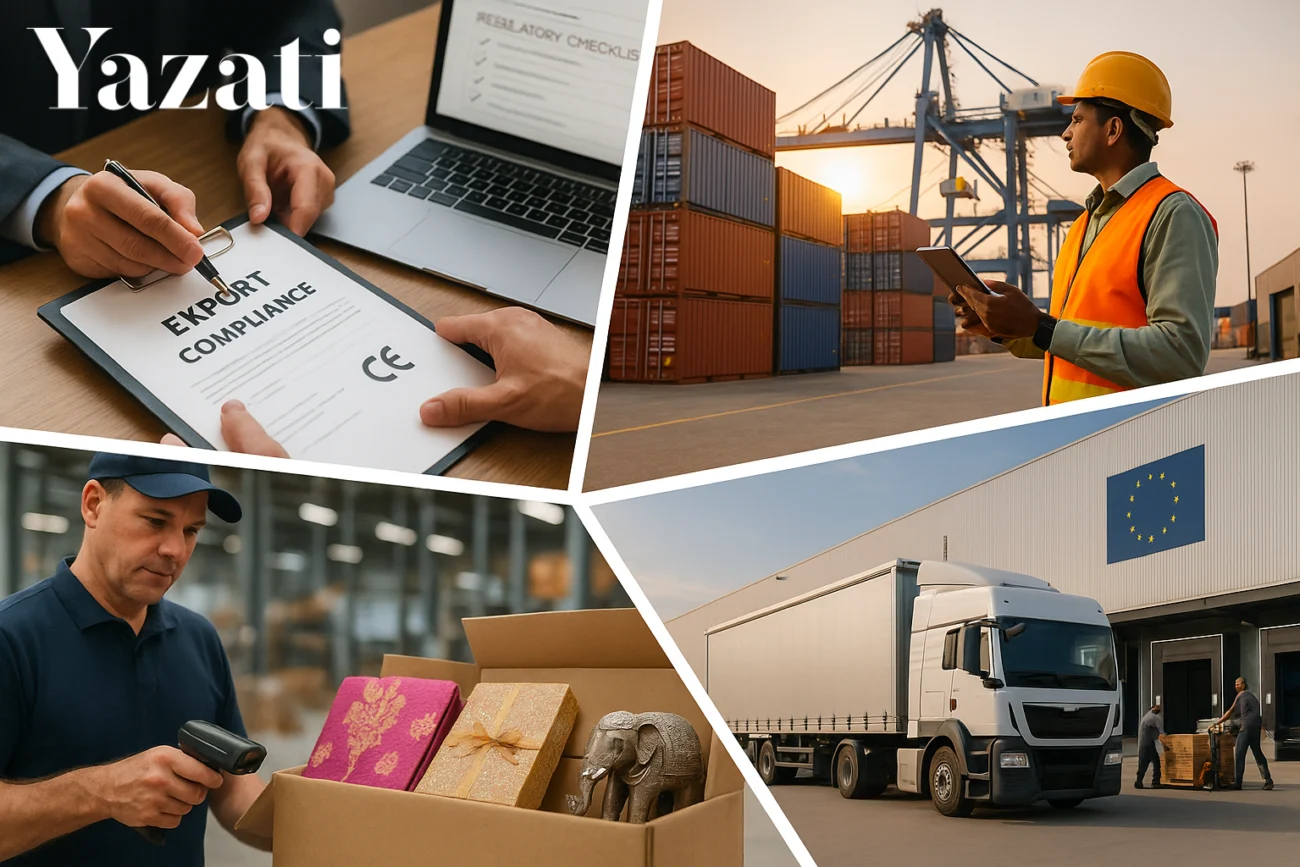
Exporting from India to Europe offers massive opportunities — but also comes with complex legal frameworks, compliance requirements, and evolving market expectations. With Europe being one of India’s largest trading partners, understanding export regulations, documentation, and certifications is key to building a sustainable export business.
This article explores the essential legal requirements and practical market tips for Indian exporters seeking to succeed in the European Union (EU) and beyond.
Understanding the India–Europe Trade Relationship
India and the European Union share a strong and growing trade partnership. In recent years, bilateral trade has exceeded $115 billion, with steady growth across diverse sectors. The EU remains India’s second-largest trading partner, accounting for nearly 14% of total exports.
European nations are major importers of Indian pharmaceuticals, textiles, IT services, and machinery. The export landscape is further strengthened by India’s competitive production costs and skilled workforce.
Major Export Destinations in Europe for Indian Businesses
Some of the most lucrative European markets for Indian exporters include:
- Germany – Leading importer of Indian engineering goods and machinery
- France – Major destination for textiles and jewelry
- The Netherlands – Gateway to Northern Europe with strong logistics infrastructure
- Italy – Key importer of leather goods and automotive parts
- Spain – Growing demand for Indian textiles and agricultural products
Each country has its own import regulations, documentation, and labeling requirements, so exporters must tailor their strategies accordingly.
Key Products Exported from India to Europe
Indian exports to Europe are diverse, covering sectors such as:
| Category | Top Products |
| Textiles & Apparel | Cotton garments, home furnishings |
| Pharmaceuticals | Generic drugs, APIs, nutraceuticals |
| Engineering Goods | Auto parts, machinery, electricals |
| Agriculture & Food | Tea, rice, spices, organic produce |
| IT & Services | Software development, consulting |
By aligning with EU quality and sustainability standards, Indian exporters can increase both market access and brand credibility.
Legal Framework for Exporting from India to Europe
Export Documentation Essentials
Every export transaction from India requires the following key documents:
- Import Export Code (IEC) from DGFT
- Commercial Invoice and Packing List
- Bill of Lading or Airway Bill
- Shipping Bill (filed with Indian Customs)
- Certificate of Origin
- Insurance Certificate
Errors in documentation can delay customs clearance and result in financial losses.
EU Import Regulations and Standards
The European Union has some of the world’s strictest import regulations to ensure product safety, environmental protection, and consumer health. Exporters must comply with:
- CE Marking for machinery, electronics, and safety-critical products
- REACH Regulation for chemicals and industrial goods
- RoHS Directive restricting hazardous substances in electronics
- EFSA Regulations for food safety and labeling
Failing to comply can lead to shipment rejection or penalties.
Customs Procedures and Tariff Codes (HS Codes)
Proper classification under Harmonized System (HS) codes is crucial. These codes determine applicable tariffs and customs procedures. Exporters can verify codes via the EU TARIC Database to ensure accuracy and compliance.
Role of DGFT (Directorate General of Foreign Trade)
The DGFT governs India’s export policy, issuing licenses, permits, and notifications relevant to European trade. Exporters should regularly check DGFT updates for policy revisions and incentive schemes.
Certification and Quality Standards for the EU Market
Europe’s customers prioritize quality, sustainability, and traceability. Key certifications that improve market acceptance include:
- ISO 9001/14001 for quality and environmental management
- Organic Certification (EU Regulation 834/2007)
- Fair Trade and FSC Labels for ethical production
- CE and GMP Certifications for product safety and pharmaceuticals
Product-Specific Compliance Requirements
- Pharmaceuticals – Must meet EU-GMP standards
- Electronics – Require CE marking and WEEE compliance
- Textiles – Must follow REACH and EcoLabel standards
- Food Products – Require traceability and labeling per EU Food Law
Taxation, Duties, and Tariff Considerations
Understanding the taxation framework and tariffs is essential for Indian exporters targeting the European market. The European Union (EU) follows a Common Customs Tariff (CCT) that applies uniformly to goods imported from non-EU countries, including India.
VAT and Import Duties
All EU member states levy Value Added Tax (VAT) on imported goods.
VAT rates differ by country:
- Germany: 19%
- France: 20%
- Netherlands: 21%
- Italy: 22%
- Spain: 21%
While exporters are not directly liable for VAT in Europe, importers or distributors often handle it during customs clearance. Indian exporters must ensure accurate invoice values and HS code classification to avoid disputes.
Tariff Reductions through Trade Negotiations
India and the EU have been in discussions for a Free Trade Agreement (FTA), which aims to lower import duties and boost bilateral trade. Until finalized, exporters can benefit from specific Generalized System of Preferences (GSP) schemes that reduce tariffs for eligible Indian goods.
Leveraging Free Trade Agreements (FTAs)
Even without a comprehensive India–EU FTA, India has trade agreements with several European nations and regional blocs. Exporters can benefit from preferential tariff access by obtaining a Certificate of Origin (CoO).
For instance:
- EU–India Cooperation Agreement (1994) facilitates trade in certain industrial goods.
- India–EFTA negotiations (with Switzerland, Norway, Iceland, and Liechtenstein) could soon offer reduced tariffs for goods entering Europe.
Tip: Always verify FTA eligibility through the DGFT portal or the EU Access2Markets database to confirm tariff benefits.
Logistics and Shipping Strategies
Efficient logistics can make or break export success. Shipping goods from India to Europe requires strategic planning, cost optimization, and reliable partnerships.
Choosing the Right Shipping Partner
Look for freight forwarders experienced in EU customs procedures and trade documentation. Popular Indian ports for European exports include:
- Nhava Sheva (JNPT) – India’s largest container port
- Chennai Port – Ideal for South Indian exporters
- Mundra Port – Efficient and privately managed
For air freight, Delhi and Mumbai are major gateways.
Using Incoterms Wisely
Incoterms (International Commercial Terms) define exporter and importer responsibilities. Common terms include:
- FOB (Free on Board) – Exporter covers shipping until goods are loaded
- CIF (Cost, Insurance & Freight) – Exporter handles freight and insurance
- DDP (Delivered Duty Paid) – Exporter bears all costs until goods reach the buyer
Common Shipping Hurdles and How to Overcome Them
| Challenge | Solution |
| Customs delays | Submit accurate documents and pre-declarations |
| Freight cost surges | Compare multiple freight agents and consolidate shipments |
| Packaging issues | Follow EU standards for labeling and eco-friendly packaging |
| Lost shipments | Use GPS tracking and insured logistics services |
Market Entry Tips for Indian Exporters
Europe is a diverse market with sophisticated consumers. Indian exporters should adopt a localized approach to win trust and meet expectations.
How to Identify Demand
- Conduct market research using tools like Eurostat, Trade Map, and Export Genius.
- Focus on niche segments like sustainable textiles, organic food, or eco-packaging.
- Attend European trade fairs such as Heimtextil (Germany) or SIAL (France) to meet buyers directly.
Building Strategic Partnerships
Partner with local distributors, importers, or agents who understand EU regulatory systems. Signing a distribution or agency agreement can accelerate market access while reducing legal risks.
Digital Platforms and E-commerce Opportunities
E-commerce offers a fast track for market entry. Platforms like:
- Amazon Europe, eBay EU, and Etsy
- Alibaba (for B2B exports)
- IndiaMART Global or TradeIndia International
These platforms allow exporters to test demand before establishing a physical presence.
Financial and Risk Management in Exporting
Cross-border trade involves currency fluctuations, delayed payments, and geopolitical risks. Effective financial management can safeguard profitability.
Export Insurance
Exporters can mitigate non-payment risks through:
- Export Credit Guarantee Corporation (ECGC) policies
- Letter of Credit (LC) and Advance Payment methods
- Forfaiting for large transactions
Foreign Exchange Management
Use forward contracts or currency hedging to protect against INR–EUR volatility. Maintain an EEFC account (Exchange Earners’ Foreign Currency) for easy fund management.
Common Mistakes Indian Exporters Should Avoid
- Ignoring EU product standards – results in rejections or bans.
- Incomplete documentation – causes customs delays.
- Lack of market research – leads to product mismatch.
- Overlooking payment terms – creates financial risks.
- Ignoring after-sales support – reduces credibility with European buyers.
Government Support and Export Promotion Schemes
The Government of India offers various incentives to encourage exports to Europe.
Major Export Schemes
| Scheme | Description |
| RoDTEP (Remission of Duties and Taxes on Exported Products) | Refunds embedded taxes and duties not refunded by other means |
| EPCG (Export Promotion Capital Goods Scheme) | Allows import of capital goods at zero customs duty |
| MAI (Market Access Initiative) | Provides financial aid for participation in trade fairs and marketing |
| TMA (Transport and Marketing Assistance) | Reduces freight costs for agricultural exporters |
Role of Export Promotion Councils (EPCs)
EPCs like FIEO, TEXPROCIL, and APEDA assist exporters with:
- Certification and documentation support
- Market insights and trade analytics
- Networking with overseas buyers
Visit https://www.fieo.org for official export guidance and upcoming trade events.
Future of India-Europe Trade Relations
The future looks bright for India-Europe trade. Both regions are focusing on green trade, digital integration, and sustainable supply chains. The upcoming India–EU FTA is expected to reduce tariffs, simplify customs procedures, and boost two-way investments.
Sectors such as renewable energy equipment, EV components, and sustainable textiles will drive the next phase of trade growth. Exporters embracing innovation and sustainability will stand out in this evolving market.
FAQs on Exporting from India to Europe
1. What is the first step to start exporting from India to Europe?
Obtain an Import Export Code (IEC) from DGFT and register your business with an Export Promotion Council.
2. Do I need CE certification for all products?
No. CE marking applies to specific categories like electronics, machinery, and toys — check the EU directive for your product type.
3. How can I find buyers in Europe?
Use B2B portals, participate in international trade fairs, and contact Indian embassies’ commercial wings in Europe.
4. What are the common export documents required?
Commercial invoice, packing list, bill of lading, certificate of origin, and insurance certificate are mandatory for most shipments.
5. Are there government incentives for first-time exporters?
Yes. Schemes like Niryat Bandhu and RoDTEP support new exporters with training and financial benefits.
6. How long does customs clearance take in the EU?
Typically 2–5 days, depending on product category and completeness of documentation.
Conclusion: Building Long-Term Success in the European Market
Exporting from India to Europe requires more than just meeting legal requirements—it’s about building trust, ensuring compliance, and offering consistent quality. By mastering documentation, adhering to EU standards, leveraging digital tools, and engaging with government export schemes, Indian exporters can unlock massive growth potential in the European market.
The Europe–India trade corridor is evolving rapidly. Exporters who stay proactive, environmentally responsible, and customer-focused will thrive in this dynamic landscape.
✨ Discover Global Sourcing Excellence with Netyex ✨
Netyex is your trusted B2B sourcing partner, connecting international buyers with India’s finest manufacturers and curated product lines—from handicrafts and home décor to kitchenware, textiles, hospitality essentials, and more. With verified suppliers and end-to-end support, we make global procurement seamless, reliable, and efficient.
👉 Elevate your sourcing experience—explore Netyex today.
📦 Bulk orders & customisation | 🌍 Worldwide delivery | 🤝 Trusted by global buyers
Visit Netyex to source premium Indian products with confidence.