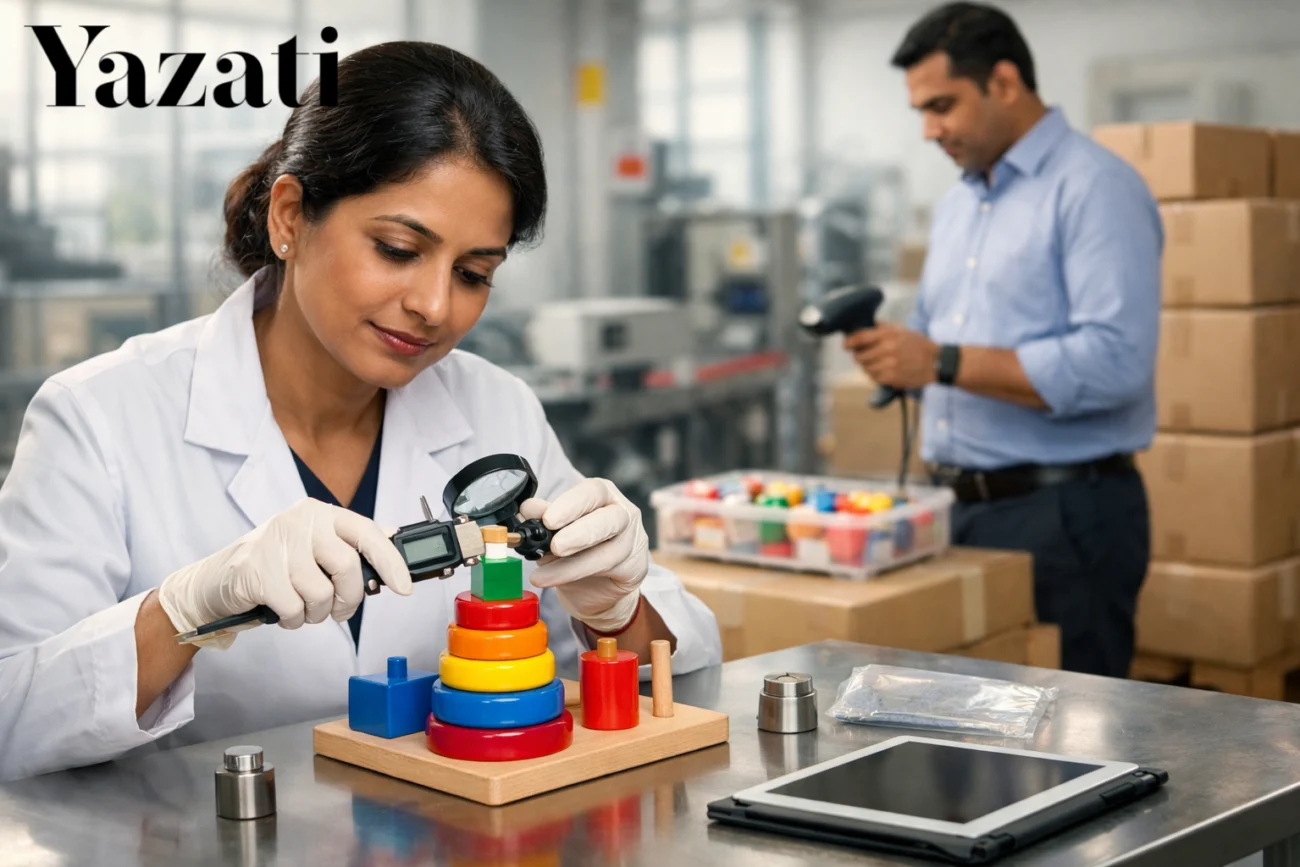
Rising Global Demand for Safe Toys
Consumers worldwide are more conscious about:
- Product safety
- Non-toxic materials
- Child-friendly designs
- Sustainable manufacturing
- Ethical production practices
Retailers and importers are under pressure to ensure strict compliance with international safety standards.
Countries that can guarantee quality, safety, and reliability are gaining an advantage. India is stepping into this space confidently.
1. Stronger Toy Safety Regulations
One of the most important reasons how India is emerging as a safe toy export hub is the implementation of stricter safety regulations.
India has introduced mandatory quality control measures requiring toy manufacturers to comply with national and international safety standards.
Manufacturers must now:
- Meet specific material safety guidelines
- Use non-toxic paints and dyes
- Follow child safety norms
- Obtain certification before market entry
Stricter regulation builds global buyer confidence.
2. Focus on BIS Certification
The Bureau of Indian Standards (BIS) certification has become mandatory for toys manufactured or imported into India.
BIS compliance ensures:
- Mechanical safety
- Chemical safety
- Flammability resistance
- Durability standards
This systematic approach ensures toys meet rigorous safety benchmarks before reaching international markets.
Certified quality increases trust.
3. Shift Toward Non-Toxic and Eco-Friendly Materials
Modern consumers demand safer materials.
Indian manufacturers are increasingly using:
- Natural wood
- Organic fabrics
- Non-toxic dyes
- Recyclable materials
This shift toward sustainable production aligns with global safety expectations.
Eco-conscious manufacturing enhances brand appeal.
4. Government Support Through “Make in India” Initiative
The government has actively promoted domestic toy manufacturing under national industrial programs.
This support includes:
- Financial incentives
- Production-linked incentives
- Infrastructure development
- Export promotion schemes
Encouraging local manufacturing reduces dependency on imports and strengthens export potential.
Policy support drives growth.
5. Development of Dedicated Toy Clusters
India has established toy manufacturing clusters in states such as:
- Karnataka
- Uttar Pradesh
- Tamil Nadu
- Maharashtra
These clusters provide:
- Shared infrastructure
- Testing facilities
- Skilled labor access
- Logistics support
Cluster development improves efficiency and standardization.
Centralized ecosystems enhance competitiveness.
6. Skilled Artisan and Manufacturing Workforce
India has a long tradition of craftsmanship in wooden toys, textile dolls, and educational products.
The country combines:
- Traditional craftsmanship
- Modern machinery
- Skilled labor
- Growing automation
This blend ensures both creativity and compliance with safety standards.
Experience strengthens export capability.
7. Increasing Compliance with International Standards
To succeed in global markets, Indian exporters are aligning with:
- European toy safety norms
- US safety regulations
- International quality certifications
Compliance ensures toys are suitable for export to developed markets.
Meeting global standards increases market access.
8. Growing Investment in Testing Laboratories
Advanced testing infrastructure is critical for safety assurance.
India is expanding accredited laboratories to test:
- Chemical composition
- Choking hazards
- Sharp edges
- Flammability
- Structural strength
Increased testing capacity improves export readiness.
Quality control ensures reliability.
9. Reduced Dependence on Single-Country Supply Chains
Global buyers are diversifying sourcing due to supply chain disruptions.
India provides:
- Political stability
- Growing industrial capacity
- Strategic geographic location
- Competitive production costs
Diversification reduces risk for global importers.
India offers a balanced sourcing alternative.
10. Rising Domestic Market Strength
India’s growing middle-class population has increased domestic demand for safe and quality toys.
A strong domestic market encourages:
- Product innovation
- Higher safety compliance
- Better quality standards
Domestic improvement strengthens export potential.
Internal growth fuels global expansion.
11. Focus on Educational and STEM Toys
India is expanding into educational and skill-development toys.
These include:
- STEM learning kits
- Puzzle games
- Montessori-inspired products
- Creative building toys
Educational toys require higher safety and quality standards.
Specialization increases export value.
12. Competitive Cost Structure
India offers competitive production costs due to:
- Affordable labor
- Local raw materials
- Efficient manufacturing clusters
Cost competitiveness combined with safety compliance creates strong export appeal.
Value-for-money attracts international buyers.
13. Growing Participation in International Trade Fairs
Indian toy manufacturers are actively participating in global exhibitions.
These platforms help:
- Showcase compliance
- Demonstrate product safety
- Build buyer relationships
- Secure international contracts
Global visibility increases trust and brand recognition.
Exposure accelerates export growth.
14. Focus on Innovation and Design Development
Modern toy markets demand creativity.
Indian manufacturers are investing in:
- Design studios
- Research and development
- Product testing
- Packaging innovation
Innovation improves market positioning.
Creative excellence strengthens brand image.
15. Increased Export Performance in Recent Years
India’s toy exports have shown steady growth.
Improved compliance, government support, and manufacturing expansion have contributed to rising export figures.
This growth signals international acceptance and confidence.
Progress reflects potential.
Challenges India Must Continue to Address
Despite strong progress, challenges remain:
- Scaling production capacity
- Maintaining consistent quality
- Competing with established global manufacturers
- Improving supply chain efficiency
Continuous improvement is necessary to sustain momentum.
Growth requires commitment.
How India Is Emerging as a Safe Toy Export Hub in the Global Market
The transformation is driven by:
- Regulatory reform
- Industry modernization
- Government support
- International compliance
- Sustainable practices
India’s approach combines safety assurance with cost efficiency.
That combination appeals strongly to global buyers.
Long-Term Outlook for Indian Toy Exports
The future looks promising.
As global demand for safe, sustainable, and diversified sourcing increases, India is well-positioned to:
- Expand export volumes
- Enter new markets
- Increase value-added production
- Strengthen global partnerships
Consistency in safety compliance will be the key driver.
Trust builds long-term success.
FAQs About How India Is Emerging as a Safe Toy Export Hub
1. What makes India’s toy exports safe?
Stricter regulations, BIS certification, and improved testing infrastructure ensure safety compliance.
2. Are Indian toys compliant with international standards?
Many manufacturers now align with European and US safety norms to expand export reach.
3. Is India competitive compared to other toy-producing countries?
Yes. India offers a combination of competitive pricing, skilled labor, and improved safety standards.
4. What types of toys does India export?
India exports wooden toys, educational kits, soft toys, plastic toys, and traditional handcrafted items.
5. Does government support play a role in toy exports?
Yes. National initiatives and export promotion policies encourage manufacturing and compliance.
6. What is the future of India’s toy export industry?
With continued investment and regulatory focus, India is expected to strengthen its position in global markets.
Conclusion
Understanding How India Is Emerging as a Safe Toy Export Hub reveals a clear and strategic transformation.
Through stronger safety regulations, improved certification processes, investment in testing facilities, and supportive government policies, India is building a reputation for reliability and quality in the global toy market.
While challenges remain, consistent progress in compliance, innovation, and manufacturing capacity positions India as a trusted export destination.
Safety, sustainability, and strategic growth — these pillars are shaping India’s journey toward becoming a leading global toy export hub.
✨ Discover Global Sourcing Excellence with Netyex ✨
Netyex is your trusted B2B sourcing partner, connecting international buyers with India’s finest manufacturers and curated product lines—from handicrafts and home décor to kitchenware, textiles, hospitality essentials, and more. With verified suppliers and end-to-end support, we make global procurement seamless, reliable, and efficient.
👉 Elevate your sourcing experience—explore Netyex today.
📦 Bulk orders & customisation | 🌍 Worldwide delivery | 🤝 Trusted by global buyers
Visit Netyex to source premium Indian products with confidence.