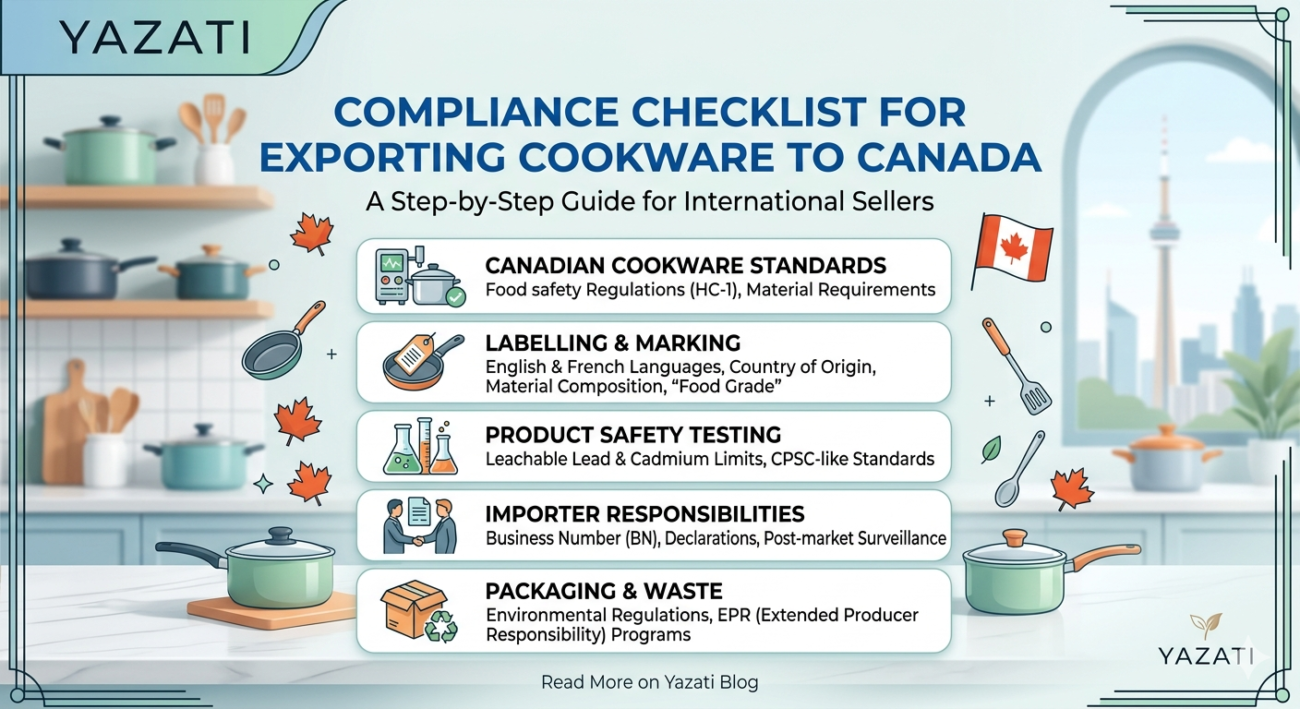
Exporting cookware products to Canada can be a profitable business opportunity for manufacturers and distributors worldwide. Canada has a growing consumer market that values quality kitchenware, eco-friendly products, and durable cookware solutions. However, entering the Canadian market requires exporters to follow strict product safety, labeling, customs, and environmental regulations.
This detailed guide on the Compliance Checklist for Exporting Cookware to Canada explains the essential legal and operational requirements businesses must meet before shipping cookware products into Canada. Whether you manufacture stainless steel pots, non-stick frying pans, cast iron cookware, or aluminum kitchen tools, understanding compliance standards is critical for avoiding delays, penalties, or product recalls.
Understanding the Canadian Cookware Market
Canada imports a large volume of cookware products every year from countries such as China, the United States, India, and European nations. Canadian consumers prioritize:
- Food-safe materials
- Durable construction
- Sustainable packaging
- Non-toxic coatings
- Energy-efficient cookware
Retailers and online marketplaces in Canada also demand high-quality compliance documentation from suppliers before listing products.
Exporters who understand Canadian regulations gain a competitive advantage and build trust with distributors, retailers, and customers.
Why Compliance Matters for Cookware Exporters
Meeting Canadian compliance standards is not optional. Imported cookware products are subject to inspection, testing, and monitoring by government agencies.
Legal Risks of Non-Compliance
Failure to comply may lead to:
- Shipment detention at customs
- Product recalls
- Monetary penalties
- Import bans
- Damage to brand reputation
- Loss of distribution contracts
Canadian authorities have strong enforcement powers under consumer protection and product safety laws.
Benefits of Meeting Canadian Standards
Compliant exporters can enjoy:
- Faster customs clearance
- Improved retailer relationships
- Better customer trust
- Reduced legal risks
- Increased sales opportunities
- Long-term market growth
Businesses that proactively follow a proper Compliance Checklist for Exporting Cookware to Canada are more likely to succeed in this competitive market.
Key Government Agencies Regulating Cookware Imports
Several Canadian government organizations oversee cookware imports and consumer safety.
Health Canada
Health Canada regulates consumer product safety under the Canada Consumer Product Safety Act (CCPSA). Cookware products that come into contact with food must meet strict chemical and material safety standards.
Official website:
https://www.canada.ca/en/health-canada.html
Canada Border Services Agency (CBSA)
Canada Border Services Agency manages import inspections, customs declarations, tariff classifications, and border clearance procedures.
The CBSA verifies:
- Product classification
- Country of origin
- Import documentation
- Duty and tax calculations
Canadian Food Inspection Agency (CFIA)
Canadian Food Inspection Agency may become involved if cookware products include food-related claims or specialty kitchen processing equipment.
Product Safety Standards for Cookware
Product safety is one of the most important parts of the Compliance Checklist for Exporting Cookware to Canada.
Material Safety Requirements
Cookware materials must be safe for food contact and free from harmful contaminants. Common approved materials include:
- Stainless steel
- Cast iron
- Aluminum
- Ceramic coatings
- Food-grade silicone
Manufacturers should maintain supplier declarations and technical material specifications.
Heavy Metal Restrictions
Canadian regulations restrict hazardous substances such as:
- Lead
- Cadmium
- Mercury
- Arsenic
Non-stick coatings and decorative paints are carefully monitored for chemical safety.
Third-party laboratory testing is strongly recommended before export.
Heat Resistance and Durability Standards
Cookware should withstand normal cooking temperatures without:
- Cracking
- Peeling
- Chemical leakage
- Structural deformation
Testing for thermal shock resistance and handle stability may be required by retailers.
Labeling Requirements for Cookware in Canada
Proper labeling is mandatory for imported cookware products.
Mandatory Bilingual Labels
Canada requires many consumer products to include both:
- English
- French
Labels should clearly display:
- Product name
- Usage instructions
- Safety warnings
- Manufacturer or importer details
Failure to provide bilingual labeling can result in customs delays.
Country of Origin Marking
Imported cookware must indicate where the product was manufactured.
Examples include:
- Made in China
- Made in India
- Manufactured in Italy
Country-of-origin labels must be accurate and visible.
Product Usage and Safety Instructions
Safety instructions help reduce liability risks. Labels may include:
- Oven-safe temperature limits
- Dishwasher compatibility
- Induction cooktop suitability
- Safe handling instructions
Clear consumer guidance improves compliance and customer satisfaction.
Packaging Compliance for Canadian Imports
Packaging regulations are becoming increasingly important in Canada.
Eco-Friendly Packaging Expectations
Canadian retailers and consumers prefer recyclable packaging materials.
Popular sustainable packaging options include:
- Recycled cardboard
- Soy-based inks
- Plastic-free inserts
- Compostable fillers
Environmentally friendly packaging can improve brand reputation.
Packaging Material Restrictions
Wood packaging materials may require compliance with international phytosanitary standards such as ISPM 15.
Restricted packaging substances may include harmful chemicals or excessive plastics.
Exporters should verify provincial packaging regulations before shipment.
Certification and Testing Requirements
Testing and certification help demonstrate compliance with Canadian standards.
Third-Party Laboratory Testing
Independent testing laboratories can verify:
- Food-contact safety
- Chemical composition
- Heavy metal limits
- Coating performance
- Heat resistance
Testing reports are often requested by Canadian retailers.
Documentation and Technical Files
Maintain organized technical documentation including:
| Required Document | Purpose |
| Test Reports | Demonstrate product safety |
| Material Declarations | Verify approved materials |
| Product Specifications | Confirm dimensions and features |
| Supplier Certifications | Validate manufacturing practices |
| Safety Data Sheets | Identify chemical components |
Well-prepared documentation speeds up customs processing.
Customs Documentation Checklist
Accurate customs paperwork is essential for smooth import clearance.
Commercial Invoice
The commercial invoice should include:
- Product description
- Unit value
- Quantity
- Currency
- Seller and buyer details
- Country of origin
Bill of Lading
The bill of lading serves as the shipping contract between exporter and carrier.
Import Permits and Tariff Codes
Proper Harmonized System (HS) tariff classification is necessary for:
- Duty assessment
- Tax calculation
- Customs reporting
Incorrect tariff codes may trigger penalties or shipment delays.
Food Contact Material Regulations
Cookware that directly touches food faces additional regulatory scrutiny.
Non-Toxic Coating Requirements
Non-stick coatings must comply with food-contact safety standards.
Manufacturers should verify that coatings are free from dangerous substances such as:
- PFOA
- Excessive PFAS compounds
- Toxic solvents
Consumer awareness around cookware chemicals is increasing rapidly in Canada.
Stainless Steel and Aluminum Standards
Metal cookware products should resist corrosion and avoid metal migration into food during cooking.
Food-grade stainless steel grades commonly include:
- 304 stainless steel
- 316 stainless steel
Proper alloy documentation is recommended.
Consumer Protection and Recall Procedures
Canadian law requires businesses to respond quickly to product safety concerns.
Mandatory Incident Reporting
Importers and manufacturers may need to report incidents involving:
- Injuries
- Fire hazards
- Product defects
- Chemical exposure risks
Health Canada enforces strict reporting timelines.
Product Recall Planning
Exporters should establish recall procedures before entering the Canadian market.
A recall plan typically includes:
- Product traceability systems
- Distributor communication procedures
- Customer notification methods
- Corrective action processes
Efficient recalls reduce legal and reputational damage.
Sustainability and Environmental Compliance
Environmental responsibility is increasingly important for cookware brands.
Canadian Environmental Regulations
Canadian provinces may impose packaging waste reduction requirements.
Businesses should monitor evolving sustainability regulations related to:
- Plastic reduction
- Recycling targets
- Waste management
Extended Producer Responsibility (EPR)
EPR programs may require companies to contribute financially toward recycling and disposal systems.
Compliance obligations vary by province.
Understanding local environmental requirements helps exporters avoid unexpected costs.
Common Mistakes Exporters Should Avoid
Many cookware exporters experience avoidable compliance issues.
Common mistakes include:
- Missing bilingual labels
- Incomplete customs documentation
- Inaccurate country-of-origin claims
- Lack of laboratory testing
- Using restricted chemical coatings
- Incorrect tariff classification
- Ignoring provincial environmental rules
Preventive compliance planning saves time and money.
Best Practices for Smooth Market Entry
To improve success when exporting cookware to Canada:
Work With Canadian Import Specialists
Customs brokers and compliance consultants can simplify market entry procedures.
Conduct Pre-Shipment Testing
Testing before export reduces the risk of border rejection.
Maintain Complete Compliance Records
Store all certificates, test reports, and technical files in an organized system.
Monitor Regulatory Updates
Canadian product regulations can change over time. Regular monitoring is essential for ongoing compliance.
Frequently Asked Questions
1. Do cookware products need bilingual labels in Canada?
Yes. Most cookware products sold in Canada require English and French labeling to comply with consumer protection laws.
2. Is laboratory testing mandatory for cookware exports to Canada?
Not always by law, but many retailers and importers require third-party testing to confirm food-contact safety and heavy metal compliance.
3. What chemicals are restricted in cookware sold in Canada?
Lead, cadmium, mercury, and certain PFAS-related substances are heavily restricted in cookware products.
4. What documents are required for Canadian cookware imports?
Typical documents include commercial invoices, bills of lading, tariff classifications, test reports, and country-of-origin declarations.
5. Can non-stick cookware be exported to Canada?
Yes, but coatings must meet Canadian food-contact safety requirements and avoid prohibited chemicals.
6. Who regulates cookware safety in Canada?
Health Canada is the primary agency responsible for cookware product safety under the Canada Consumer Product Safety Act.
Conclusion
Successfully entering the Canadian cookware market requires careful preparation and strong regulatory awareness. Exporters must focus on product safety, bilingual labeling, food-contact compliance, customs documentation, and environmental responsibilities.
Following a complete Compliance Checklist for Exporting Cookware to Canada helps businesses minimize risk, improve customs clearance efficiency, and build long-term success in Canada’s competitive consumer goods market.
Companies that prioritize compliance not only avoid legal problems but also strengthen customer trust and retailer confidence. With proper testing, accurate labeling, organized documentation, and sustainable business practices, cookware exporters can establish a reliable and profitable presence in Canada.
✨ Discover Global Sourcing Excellence with Netyex ✨
Netyex is your trusted B2B sourcing partner, connecting international buyers with India’s finest manufacturers and curated product lines—from handicrafts and home décor to kitchenware, textiles, hospitality essentials, and more. With verified suppliers and end-to-end support, we make global procurement seamless, reliable, and efficient.
👉 Elevate your sourcing experience—explore Netyex today.
📦 Bulk orders & customisation | 🌍 Worldwide delivery | 🤝 Trusted by global buyers
Visit Netyex to source premium Indian products with confidence.