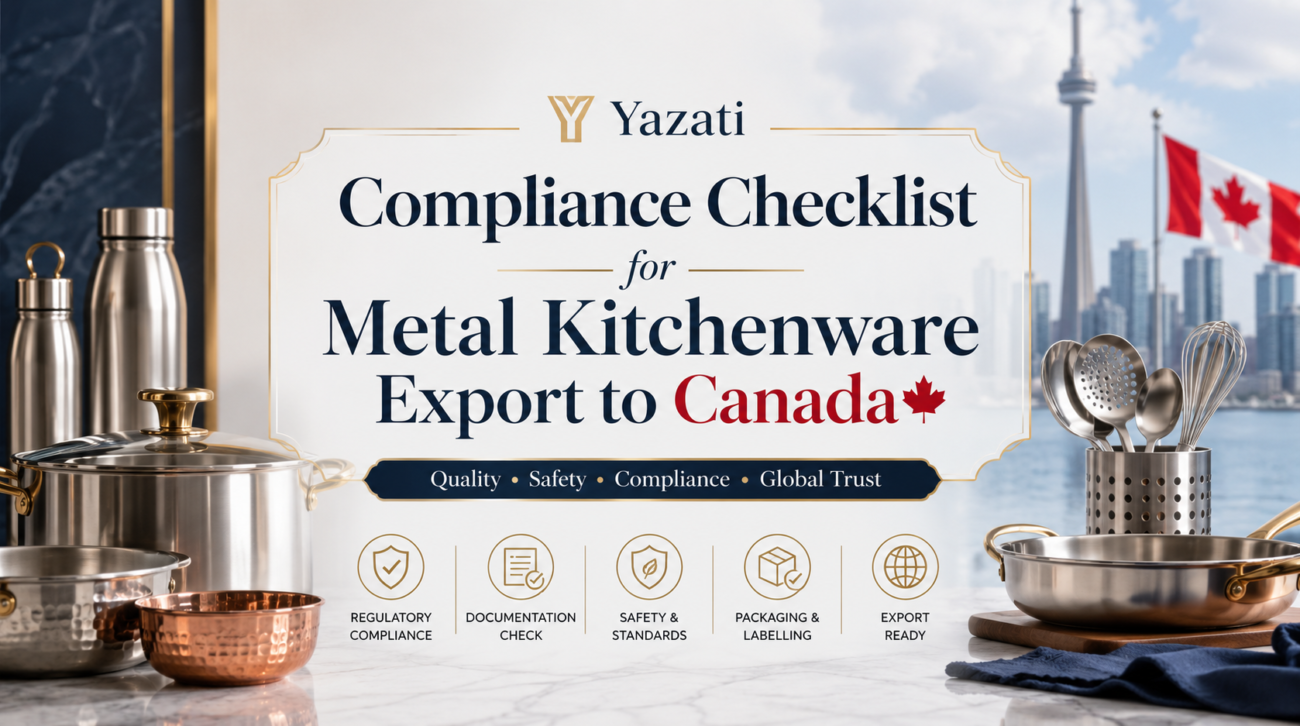
Exporting metal kitchenware to Canada can be a profitable business opportunity. However, Canadian import regulations are strict, especially for products that come into contact with food. Businesses exporting cookware, utensils, baking trays, stainless steel containers, and similar products must comply with multiple safety, labeling, and customs requirements.
This detailed Compliance Checklist for Metal Kitchenware Export to Canada will help manufacturers, exporters, and traders understand the legal framework, avoid shipment delays, and maintain product quality standards.
Understanding Canada’s Import Regulations for Metal Kitchenware
Canada maintains strict consumer safety standards for imported kitchenware products. Metal kitchenware items such as pots, pans, cutlery, utensils, and food storage containers fall under food-contact product regulations.
The primary purpose of these regulations is to ensure that harmful substances do not migrate into food during cooking, storage, or serving.
Several agencies oversee imported kitchenware products in Canada, including:
- Health Canada
- Canadian Food Inspection Agency
- Canada Border Services Agency
Exporters should understand each authority’s role before shipping products.
Role of Health Canada
Health Canada regulates materials that come into direct contact with food. The agency evaluates whether metal products release unsafe levels of chemicals or heavy metals into food.
Manufacturers should ensure products meet food-contact safety standards before entering the Canadian market.
Canadian Food Inspection Agency (CFIA) Overview
Canadian Food Inspection Agency monitors food-related safety issues and may inspect imported products if contamination concerns arise.
Although kitchenware is not food itself, products interacting with food may still face compliance scrutiny.
Product Safety Standards for Metal Kitchenware
The most critical part of the Compliance Checklist for Metal Kitchenware Export to Canada is product safety.
Canadian authorities expect imported kitchenware to be durable, food-safe, and free from hazardous materials.
Food Contact Material Requirements
Metal kitchenware must not transfer harmful substances into food under normal usage conditions.
Common regulated materials include:
- Stainless steel
- Aluminum
- Cast iron
- Copper-coated cookware
- Non-stick metal cookware
Exporters should verify that coatings, paints, and finishes are food-safe.
Heavy Metal Restrictions
Canada places restrictions on toxic substances such as:
- Lead
- Cadmium
- Mercury
- Arsenic
Products with painted surfaces, decorative coatings, or colored finishes face additional scrutiny.
Testing is highly recommended for:
- Enamel cookware
- Painted utensils
- Decorative serving trays
- Imported cutlery sets
Stainless Steel Grade Expectations
Food-grade stainless steel is preferred for Canadian imports.
Common accepted grades include:
| Stainless Steel Grade | Typical Usage |
|---|---|
| 304 Stainless Steel | Cutlery, cookware |
| 316 Stainless Steel | Premium cookware |
| 430 Stainless Steel | Kitchen accessories |
Higher corrosion resistance improves consumer trust and product acceptance.
Labeling Requirements for Canadian Imports
Proper labeling is mandatory for kitchenware imports into Canada.
Failure to meet labeling standards may result in customs delays or rejected shipments.
Mandatory English and French Labels
Canada requires bilingual labeling for many consumer products.
Labels should include:
- Product name
- Material composition
- Safety instructions
- Manufacturer details
- Importer information
Both English and French text should appear clearly.
Example:
| English | French |
|---|---|
| Stainless Steel Spoon | Cuillère en acier inoxydable |
| Dishwasher Safe | Va au lave-vaisselle |
Country of Origin Marking
Products must clearly display their manufacturing origin.
Examples:
- Made in India
- Made in China
- Manufactured in Vietnam
Origin labeling helps customs authorities and consumers identify product sources.
Product Usage Instructions
Kitchenware products should include safe-use instructions when applicable.
Examples include:
- Oven-safe temperature limits
- Dishwasher compatibility
- Induction cooktop suitability
- Handwash recommendations
Clear instructions reduce liability risks.
Packaging Compliance Checklist
Packaging quality is another important part of the Compliance Checklist for Metal Kitchenware Export to Canada.
Safe Packaging Materials
Packaging materials should:
- Protect products during shipping
- Prevent contamination
- Avoid toxic inks or adhesives
Corrugated cardboard and recyclable protective inserts are commonly used.
Eco-Friendly Packaging Rules
Canada increasingly encourages sustainable packaging solutions.
Exporters should minimize:
- Excessive plastic usage
- Non-recyclable foam
- Hazardous packaging materials
Environmentally responsible packaging can improve brand image.
Customs Documentation Requirements
Incorrect paperwork is one of the most common causes of shipment delays.
Commercial Invoice
The invoice should contain:
- Product description
- Quantity
- Unit price
- Country of origin
- Buyer and seller details
- Currency used
Descriptions should match the actual goods exactly.
Bill of Lading
This document confirms shipment ownership and transportation details.
It should align with all customs paperwork.
Certificate of Origin
Some trade agreements may reduce import duties.
A Certificate of Origin may help importers qualify for tariff benefits.
Canadian Tariff Classification and HS Codes
Correct tariff classification is essential for customs clearance.
Common HS Codes for Kitchenware
| Product Type | Example HS Code |
|---|---|
| Stainless Steel Tableware | 7323 |
| Aluminum Kitchenware | 7615 |
| Iron or Steel Household Articles | 7323.93 |
Always confirm the latest classification with customs professionals.
Duties and Tax Considerations
Importers may need to pay:
- Customs duties
- Goods and Services Tax (GST)
- Provincial taxes
Tax obligations vary depending on product category and trade agreements.
Testing and Certification Requirements
Testing strengthens compliance confidence.
Third-Party Laboratory Testing
Independent laboratories can verify:
- Heavy metal limits
- Corrosion resistance
- Food-contact safety
- Coating durability
Testing reports may support customs inspections.
Relevant standards may reference organizations such as:
- ASTM International
- International Organization for Standardization
Compliance Testing Reports
Keep digital and printed copies of:
- Material test certificates
- Food safety reports
- Factory inspection records
- Product specifications
These documents help during audits or inspections.
Product Recall and Traceability Rules
Canada expects importers and manufacturers to maintain traceability systems.
Recall Preparedness
Businesses should establish procedures for:
- Product recalls
- Consumer complaints
- Defect investigations
Fast response systems reduce legal and reputational risks.
Batch Tracking Systems
Tracking systems should identify:
- Production batch numbers
- Manufacturing dates
- Supplier sources
Traceability improves supply chain control.
Importer Responsibilities in Canada
Importers share responsibility for compliance.
Non-Resident Importer (NRI) Model
Many exporters use the Non-Resident Importer model to sell directly into Canada.
Under this setup, exporters may handle:
- Duties
- Taxes
- Customs procedures
This simplifies purchasing for Canadian buyers.
Working With Canadian Distributors
Partnering with experienced Canadian distributors can help exporters:
- Navigate regulations
- Manage labeling
- Handle customs clearance
- Improve local market access
Common Mistakes Exporters Should Avoid
Avoiding compliance errors saves time and money.
Incorrect Product Labeling
Missing bilingual labels is a common issue.
Always verify translation accuracy.
Missing Safety Documentation
Customs authorities may request proof of food-contact safety.
Incomplete records can delay shipments.
Poor Packaging Standards
Weak packaging may lead to:
- Product damage
- Customer complaints
- Returned shipments
Investing in strong export packaging is essential.
Step-by-Step Compliance Checklist for Exporters
Here is a simplified Compliance Checklist for Metal Kitchenware Export to Canada:
| Checklist Item | Status |
|---|---|
| Verify food-contact safety | ✔ |
| Test for heavy metals | ✔ |
| Confirm bilingual labeling | ✔ |
| Add country of origin marking | ✔ |
| Use compliant packaging | ✔ |
| Prepare customs documents | ✔ |
| Verify HS codes | ✔ |
| Maintain traceability records | ✔ |
| Keep laboratory test reports | ✔ |
| Review importer responsibilities | ✔ |
Frequently Asked Questions
1. Is bilingual labeling mandatory in Canada?
Yes. Most consumer products, including kitchenware, should display information in both English and French.
2. Do metal kitchenware products require laboratory testing?
While not always legally mandatory, testing is strongly recommended to verify food-contact safety and heavy metal compliance.
3. Which metals are commonly restricted in kitchenware imports?
Lead, cadmium, mercury, and arsenic are among the most regulated substances.
4. Can exporters ship directly to Canadian consumers?
Yes. Many businesses use the Non-Resident Importer (NRI) model to sell directly into Canada.
5. What documents are required for customs clearance?
Typical documents include:
- Commercial invoice
- Bill of lading
- Packing list
- Certificate of origin
6. Are eco-friendly packaging materials required?
Canada encourages sustainable packaging practices, though exact requirements vary by province and product category.
Conclusion
Following a proper Compliance Checklist for Metal Kitchenware Export to Canada is essential for successful international trade. Canadian authorities prioritize consumer safety, food-contact compliance, accurate labeling, and proper customs documentation.
Exporters who invest in quality testing, bilingual labeling, traceability systems, and compliant packaging are more likely to build long-term success in the Canadian market.
For official guidance, exporters can review Canadian regulations through Health Canada and Canada Border Services Agency.
✨ Discover Global Sourcing Excellence with Netyex ✨
Netyex is your trusted B2B sourcing partner, connecting international buyers with India’s finest manufacturers and curated product lines—from handicrafts and home décor to kitchenware, textiles, hospitality essentials, and more. With verified suppliers and end-to-end support, we make global procurement seamless, reliable, and efficient.
👉 Elevate your sourcing experience—explore Netyex today.
📦 Bulk orders & customisation | 🌍 Worldwide delivery | 🤝 Trusted by global buyers
Visit Netyex to source premium Indian products with confidence.