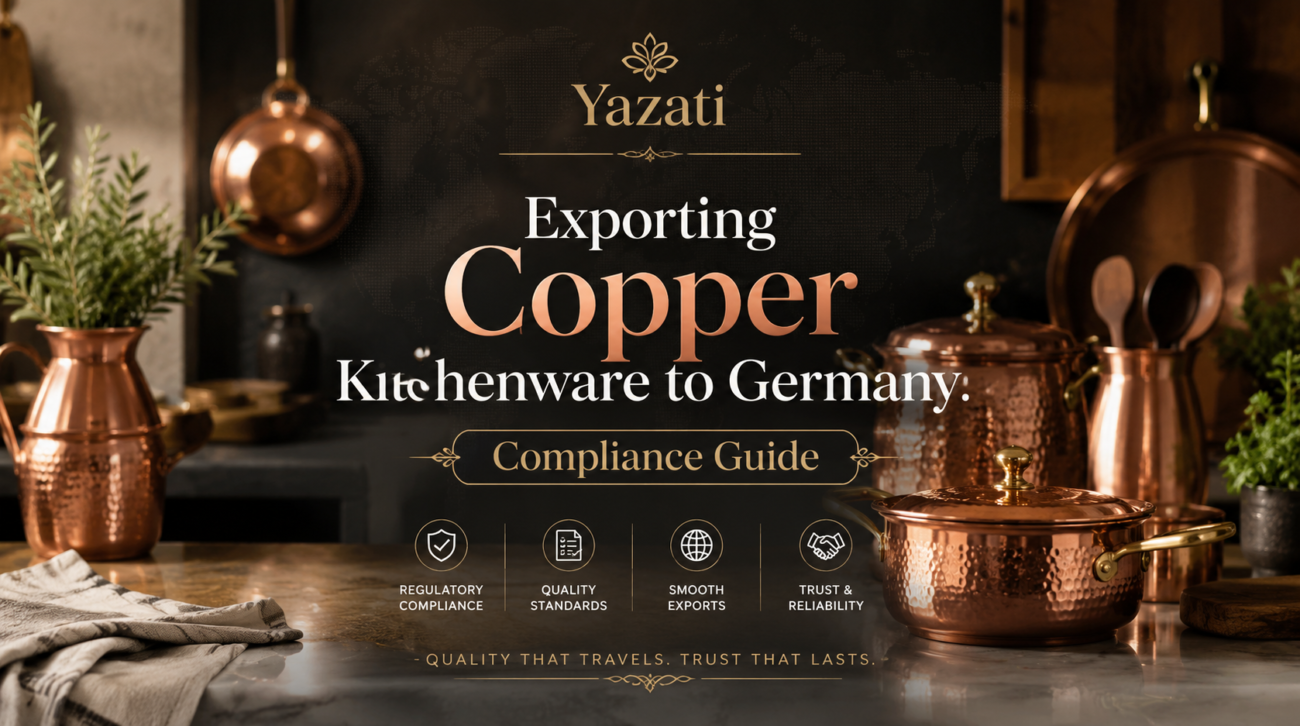
Germany is one of Europe’s largest importers of premium cookware and kitchen products. For manufacturers and exporters, Exporting Copper Kitchenware to Germany offers strong business opportunities, especially as German consumers increasingly prefer sustainable, durable, and aesthetically pleasing kitchenware.
However, entering the German market is not as simple as shipping products overseas. Exporters must comply with strict European Union regulations, German food safety laws, environmental packaging requirements, customs procedures, and labeling standards.
This guide explains everything you need to know to export copper kitchenware successfully to Germany while staying compliant with all legal requirements.
Understanding the German Market for Copper Kitchenware
Germany has a mature cookware market with strong demand for premium-quality kitchen products. Copper cookware is especially valued for its excellent heat conductivity, elegant appearance, and professional-grade performance.
Why Germany Imports Premium Copper Cookware
German consumers appreciate products that combine functionality with craftsmanship. Copper pots, pans, mugs, and utensils are popular among:
- Professional chefs
- High-income households
- Boutique kitchen retailers
- Luxury hospitality businesses
Many German buyers also seek handcrafted and artisanal cookware that reflects sustainability and traditional manufacturing methods.
Market Trends in Sustainable Kitchenware
Sustainability is a major purchasing factor in Germany. Buyers increasingly prefer:
- Recyclable materials
- Long-lasting cookware
- Plastic-free packaging
- Eco-friendly production methods
Exporters who highlight environmentally responsible manufacturing gain a competitive advantage.
Key EU Regulations for Copper Kitchenware Imports
Before Exporting Copper Kitchenware to Germany, understanding European Union regulations is essential.
European Union Food Contact Materials Regulation
Copper kitchenware falls under EU Food Contact Materials (FCM) regulations because the products come into contact with food.
Regulation EC No. 1935/2004 Explained
This regulation ensures that food-contact products do not:
- Release harmful substances into food
- Alter food taste or smell
- Endanger human health
Copper cookware manufacturers must demonstrate product safety through testing and documentation.
Good Manufacturing Practice (GMP) Requirements
Under Regulation EC 2023/2006, manufacturers must follow Good Manufacturing Practices.
Requirements include:
- Controlled production processes
- Quality assurance systems
- Traceability documentation
- Hygienic manufacturing conditions
Failure to comply can lead to customs rejection or product recalls.
REACH Compliance for Copper Products
The EU REACH Regulation controls chemicals used in manufactured products.
Exporters must ensure that:
- Copper alloys do not contain restricted substances
- Hazardous chemicals remain below permitted limits
- Safety Data Sheets (SDS) are available if required
You can review official EU guidance here:
https://ec.europa.eu/environment/chemicals/reach/reach_en.htm
German Food Safety Standards for Kitchenware
Germany applies strict food safety monitoring for imported cookware products.
Heavy Metal Migration Testing
Testing laboratories evaluate whether harmful metals migrate from cookware into food.
Copper Release Limits
Excessive copper exposure can be harmful. German authorities may require migration tests for:
- Copper pots
- Copper mugs
- Copper-coated utensils
- Decorative food-contact items
Nickel and Lead Restrictions
Many copper products contain alloys or linings involving nickel or lead. EU laws heavily restrict these substances.
Products exceeding migration limits can face:
- Import bans
- Product recalls
- Fines
- Destruction of goods
Laboratory Testing and Certification
Testing should be conducted by accredited laboratories recognized under EU standards.
Common tests include:
| Test Type | Purpose |
|---|---|
| Heavy Metal Migration | Detect copper, lead, cadmium release |
| Food Contact Safety | Ensure consumer safety |
| Material Composition | Verify alloy content |
| Surface Coating Analysis | Confirm lining safety |
Product Labeling Requirements in Germany
Correct labeling is essential when Exporting Copper Kitchenware to Germany.
Mandatory German Language Labels
Product labels should include:
- Product name
- Material composition
- Usage instructions
- Safety warnings
- Importer details
German-language labeling is highly recommended and often expected by retailers.
Country of Origin Marking
Products should clearly state:
Made in India
Made in Turkey
Made in Morocco
Or the relevant country of manufacture.
Care Instructions and Safety Warnings
Copper cookware often requires special maintenance.
Labels should explain:
- Cleaning instructions
- Compatibility with induction stoves
- Whether the product is tin-lined or stainless-lined
- Dishwasher suitability
Packaging and Environmental Compliance
Germany has some of the strictest packaging laws in Europe.
Germany’s Packaging Act (VerpackG)
Any company placing packaged goods into the German market must comply with VerpackG.
LUCID Packaging Register
Exporters or importers must register with Germany’s LUCID packaging system.
Requirements include:
- Packaging volume reporting
- Recycling participation
- Registration with dual systems
Failure to register may result in sales bans.
Recycling Responsibilities
Packaging materials should be:
- Recyclable
- Reduced in waste
- Properly labeled
Eco-friendly packaging helps build trust with German consumers.
Customs Documentation for Exporting
Accurate paperwork is critical for customs clearance.
Commercial Invoice Requirements
The invoice should contain:
- Buyer and seller details
- Product description
- HS code
- Quantity
- Unit value
- Country of origin
Certificate of Origin
German importers may request a Certificate of Origin to verify manufacturing origin.
HS Codes for Copper Kitchenware
Common HS codes include:
| Product | HS Code |
|---|---|
| Copper cookware | 7418 |
| Copper tableware | 7418.10 |
| Household copper articles | 7418.99 |
Always verify classification with a customs expert.
CE Marking and Product Certifications
Many exporters mistakenly assume all kitchenware needs CE marking.
When CE Marking Is Required
Copper kitchenware generally does not require CE marking unless it includes:
- Electrical components
- Heating systems
- Electronic functions
Additional Voluntary Certifications
Helpful certifications include:
- LFGB Certification
- SGS testing reports
- ISO 9001 certification
- Food-safe compliance reports
German buyers often prefer independently certified products.
Logistics and Shipping Considerations
Efficient logistics improve profitability and buyer satisfaction.
Choosing Air vs Sea Freight
| Shipping Method | Advantages | Disadvantages |
|---|---|---|
| Air Freight | Faster delivery | Higher cost |
| Sea Freight | Lower cost | Longer transit time |
Most exporters use sea freight for bulk shipments.
Incoterms for German Buyers
Common Incoterms include:
- FOB (Free on Board)
- CIF (Cost, Insurance, Freight)
- DDP (Delivered Duty Paid)
Clarify responsibilities carefully before shipment.
VAT and Import Duties in Germany
Import VAT Structure
Germany charges import VAT on imported goods.
The standard VAT rate is generally 19%.
Duty Rates for Copper Kitchenware
Duty rates depend on:
- Product classification
- Country of origin
- Trade agreements
Check the EU TARIC database for updated duty information.
Finding German Buyers and Distributors
Building reliable distribution channels is essential.
Trade Fairs and B2B Platforms
Popular trade fairs include:
- Ambiente Frankfurt
- Tendence
- Heimtextil
B2B marketplaces also help identify importers and wholesalers.
Working with Import Agents
German import agents can help with:
- Market entry
- Customs procedures
- Retail distribution
- Compliance verification
Common Compliance Mistakes to Avoid
Incomplete Documentation
Missing paperwork is one of the most common causes of customs delays.
Always verify:
- Test reports
- Invoices
- Labels
- Certificates
Incorrect Testing Procedures
Using non-accredited laboratories may invalidate compliance documents.
Work only with recognized testing agencies.
FAQs About Exporting Copper Kitchenware to Germany
1. Is copper cookware allowed in Germany?
Yes, copper cookware is allowed if it complies with EU food safety and chemical regulations.
2. Does copper kitchenware require CE marking?
Usually no. CE marking is generally unnecessary unless electrical components are included.
3. What testing is required for copper cookware?
Heavy metal migration testing and food-contact safety testing are commonly required.
4. Is German-language labeling mandatory?
While not always legally mandatory, German-language labels are strongly recommended for retail sales.
5. What is VerpackG compliance?
It is Germany’s packaging law requiring registration and recycling participation for packaged goods.
6. Can exporters sell directly to German consumers online?
Yes, but they must still comply with VAT, packaging, and consumer protection laws.
Conclusion
Exporting Copper Kitchenware to Germany can be highly profitable when exporters understand and follow the necessary compliance requirements. Germany values premium-quality cookware, but regulators and buyers expect strict adherence to EU food safety laws, packaging regulations, chemical restrictions, and customs procedures.
Successful exporters focus on:
- Proper laboratory testing
- Accurate documentation
- Sustainable packaging
- Reliable logistics
- German-language labeling
By meeting these standards, exporters can build long-term relationships with German importers and establish a strong presence in one of Europe’s most attractive kitchenware markets.
✨ Discover Global Sourcing Excellence with Netyex ✨
Netyex is your trusted B2B sourcing partner, connecting international buyers with India’s finest manufacturers and curated product lines—from handicrafts and home décor to kitchenware, textiles, hospitality essentials, and more. With verified suppliers and end-to-end support, we make global procurement seamless, reliable, and efficient.
👉 Elevate your sourcing experience—explore Netyex today.
📦 Bulk orders & customisation | 🌍 Worldwide delivery | 🤝 Trusted by global buyers
Visit Netyex to source premium Indian products with confidence.