Introduction to Exporting Copper Products to France
France is one of the largest industrial economies in Europe and represents a significant market for copper products used in construction, electrical systems, renewable energy projects, automotive manufacturing, and industrial applications. Exporting copper products to France requires compliance with both European Union regulations and specific French market requirements.
A successful export strategy depends on understanding customs procedures, product safety rules, environmental regulations, chemical compliance obligations, and proper documentation. Failure to comply may result in customs delays, product recalls, penalties, or rejection of shipments.
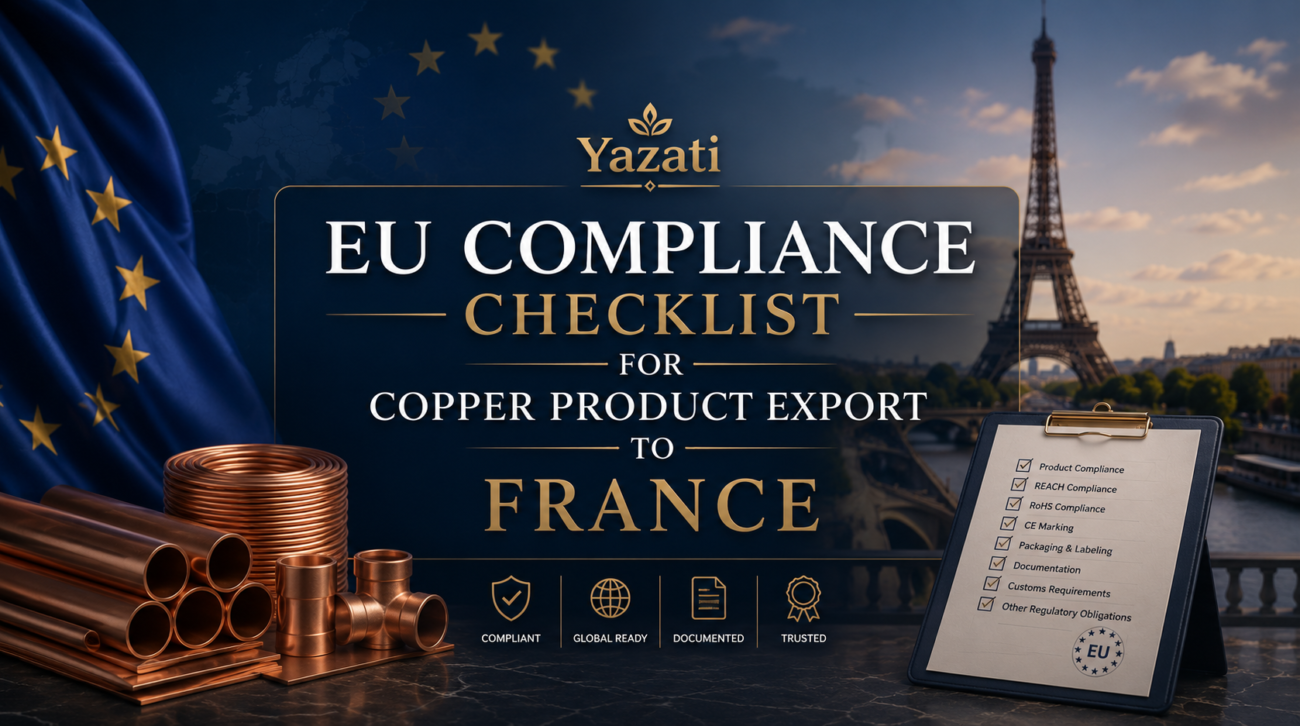
This guide provides a practical EU Compliance Checklist for Copper Product Export to France that exporters can use before shipping goods to the French market.
Understanding the EU Regulatory Framework
The European Union operates as a single market, meaning products legally placed on one EU market can generally circulate freely throughout the EU.
European Union Market Access Rules
Exporters must ensure that copper products comply with:
- EU product safety regulations
- Environmental regulations
- Customs regulations
- Chemical substance restrictions
- Packaging waste directives
- Market surveillance requirements
The official EU regulatory portal can be found at:
French National Requirements
Although most product regulations are harmonized across the EU, France may impose additional obligations related to:
- Product labeling
- Environmental reporting
- Waste management registration
- Extended Producer Responsibility (EPR)
Importers often require proof of compliance before accepting shipments.
Product Classification and HS Codes
Accurate tariff classification is one of the most important export requirements.
Determining the Correct Tariff Classification
Copper products may fall under various Harmonized System (HS) codes depending on their form:
| Product Type | Example HS Chapter |
|---|---|
| Copper Cathodes | Chapter 74 |
| Copper Wire | Chapter 74 |
| Copper Tubes and Pipes | Chapter 74 |
| Copper Fittings | Chapter 74 |
| Copper Alloys | Chapter 74 |
| Copper Components for Electrical Equipment | Various Chapters |
Incorrect classification can lead to:
- Customs penalties
- Incorrect duty payments
- Shipment delays
Always verify codes using the EU Combined Nomenclature (CN).
CE Marking Requirements
When CE Marking Applies to Copper Products
Raw copper materials generally do not require CE marking.
However, CE marking may be required when copper products are incorporated into:
- Construction products
- Electrical equipment
- Machinery
- Pressure equipment
- Electronic assemblies
Examples include:
- Copper electrical conductors
- Copper components in electrical systems
- Copper plumbing products covered by harmonized standards
Determine whether the final product falls under applicable EU directives before shipment.
REACH Compliance
Registration, Evaluation, Authorization, and Restriction of Chemicals
The EU’s REACH Regulation is one of the most important compliance obligations.
Copper exporters must evaluate whether:
- Copper substances require registration
- Articles contain substances of very high concern (SVHCs)
- Safety information must be provided
REACH applies to:
- Copper compounds
- Copper alloys
- Surface-treated products
- Coated copper products
Compliance activities may include:
- Supplier declarations
- Material composition analysis
- Safety Data Sheets (SDS)
Failure to comply can result in products being prohibited from entering the EU market.
RoHS Compliance Considerations
Restricted Hazardous Substances
If copper products are used in electrical or electronic equipment, RoHS compliance may apply.
Restricted substances include:
- Lead
- Mercury
- Cadmium
- Hexavalent chromium
- PBB
- PBDE
- Certain phthalates
Testing may be required to verify compliance.
Manufacturers should maintain:
- Test reports
- Material declarations
- Technical documentation
Product Safety Requirements
General Product Safety Regulation (GPSR)
The EU General Product Safety Regulation requires products placed on the market to be safe.
Exporters should maintain:
- Product specifications
- Manufacturing records
- Quality control procedures
- Risk assessments
French authorities may request documentation during inspections.
Environmental and Sustainability Obligations
Circular Economy Expectations
The EU strongly promotes sustainable materials and recycling.
Copper is highly recyclable and aligns well with EU sustainability objectives.
Exporters should be prepared to provide:
- Recycled content information
- Environmental declarations
- Sustainability certifications
- Carbon footprint data (if requested)
Increasingly, buyers use sustainability criteria when selecting suppliers.
Packaging and Packaging Waste Compliance
Extended Producer Responsibility (EPR)
France has extensive EPR requirements.
Businesses introducing packaged goods into France may need:
- EPR registration
- Eco-contribution payments
- Packaging reporting
Packaging should comply with:
- Heavy metal restrictions
- Recycling requirements
- Waste reduction objectives
Typical packaging documentation includes:
- Material composition declarations
- Recycling information
- Packaging specifications
Customs Documentation Requirements
Proper documentation is critical for customs clearance.
Commercial Invoice
The invoice should include:
- Exporter details
- Importer details
- Product description
- HS code
- Unit value
- Total value
- Incoterms
- Country of origin
Packing List
The packing list should specify:
- Number of packages
- Weight
- Dimensions
- Product identification
Certificate of Origin
Many French importers request certificates of origin to confirm product provenance.
Depending on trade agreements, preferential tariffs may also apply.
Import Duties and VAT in France
Tariff Calculations
Import costs generally include:
| Cost Component | Description |
|---|---|
| Customs Duty | Based on HS code |
| Import VAT | Applied in France |
| Customs Clearance Fees | Broker charges |
| Port Charges | Handling fees |
Import VAT in France is typically recoverable by VAT-registered businesses.
Technical Standards and Certifications
EN Standards for Copper Products
French customers often request compliance with European Standards (EN).
Common examples include:
- Copper tubes
- Copper rods
- Copper sheets
- Electrical conductors
Documentation may include:
- Test certificates
- Mill certificates
- Inspection reports
- Third-party laboratory reports
Compliance with EN standards significantly improves market acceptance.
Supply Chain Due Diligence
Conflict Minerals Considerations
Although copper is not generally classified as a conflict mineral under major EU conflict mineral regulations, customers increasingly request:
- Responsible sourcing declarations
- ESG documentation
- Supplier codes of conduct
- Ethical sourcing certifications
Many multinational buyers have strict procurement policies.
Labeling Requirements
Language and Product Information
Labels should generally include:
- Product identification
- Manufacturer details
- Batch number
- Safety warnings (if applicable)
- Technical specifications
French-language information may be required for products intended for end users.
Clear labeling helps avoid customs and market surveillance issues.
Logistics and Transportation Compliance
Incoterms and Shipping Documentation
Common Incoterms include:
- EXW
- FOB
- CFR
- CIF
- DAP
- DDP
Shipping documentation typically includes:
- Bill of Lading
- Air Waybill
- Commercial Invoice
- Packing List
- Insurance Documents
Exporters should verify responsibilities under the chosen Incoterm.
Risk Management and Common Compliance Mistakes
Common exporter mistakes include:
- Incorrect HS classification.
- Missing REACH documentation.
- Incomplete technical files.
- Failure to meet EPR obligations.
- Incorrect product labeling.
- Lack of supplier declarations.
- Missing certificates of origin.
- Non-compliant packaging materials.
Best practice is to conduct a pre-shipment compliance audit before every export.
Frequently Asked Questions
1. Do all copper products require CE marking?
No. Raw copper materials generally do not require CE marking, but copper products incorporated into regulated products may require it.
2. Is REACH compliance mandatory for copper exports to France?
Yes. REACH obligations apply to many substances, mixtures, and articles entering the EU market.
3. Are Safety Data Sheets required?
They may be required depending on the product type and chemical composition.
4. Do copper exporters need EPR registration in France?
In many cases, yes, particularly when packaging obligations apply.
5. Are French-language labels mandatory?
For many consumer-facing products, French information is required.
6. How can exporters verify EU standards compliance?
Through accredited laboratory testing, third-party certification, and compliance with applicable EN standards.
7. What documents are most important for customs clearance?
Commercial invoice, packing list, certificate of origin, transport documents, and compliance certificates.
8. Can recycled copper be exported to France?
Yes, provided it complies with EU regulations and any applicable waste shipment rules.
Conclusion
Successfully exporting copper products to France requires careful attention to EU and French regulatory requirements. Companies should verify product classification, assess CE marking obligations, ensure REACH and RoHS compliance where applicable, maintain technical documentation, comply with packaging and EPR obligations, and prepare complete customs documentation.
A structured compliance program not only minimizes regulatory risk but also enhances customer confidence and long-term access to the French and broader European markets.
✨ Discover Global Sourcing Excellence with Netyex ✨
Netyex is your trusted B2B sourcing partner, connecting international buyers with India’s finest manufacturers and curated product lines—from handicrafts and home décor to kitchenware, textiles, hospitality essentials, and more. With verified suppliers and end-to-end support, we make global procurement seamless, reliable, and efficient.
👉 Elevate your sourcing experience—explore Netyex today.
📦 Bulk orders & customisation | 🌍 Worldwide delivery | 🤝 Trusted by global buyers
Visit Netyex to source premium Indian products with confidence.