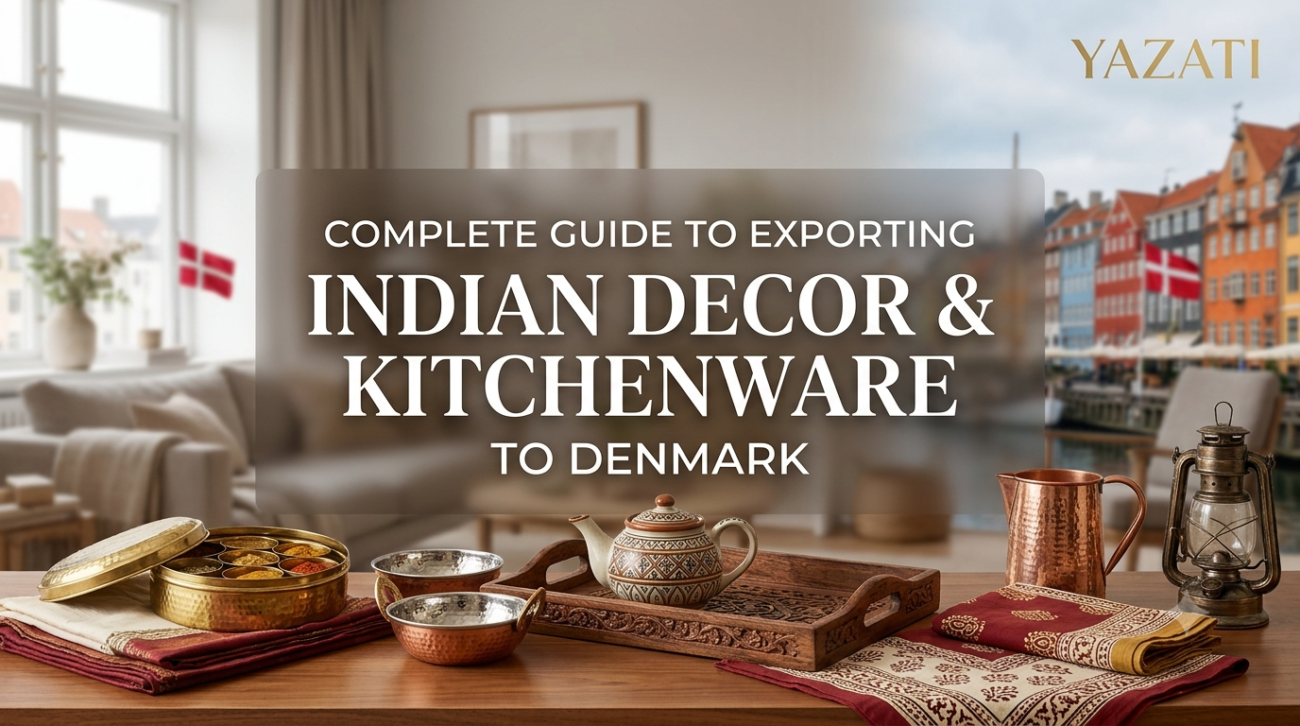
Denmark is one of Europe’s most attractive markets for premium home décor, handcrafted products, and sustainable kitchenware. Danish consumers appreciate minimalist design, quality craftsmanship, eco-friendly materials, and ethically sourced products. These preferences create an excellent opportunity for Indian manufacturers and exporters specializing in handcrafted décor, wooden products, metal handicrafts, ceramics, textiles, and kitchen accessories.
India has long been recognized for its rich tradition of craftsmanship. From handcrafted brass décor and wooden serving trays to ceramic dinnerware and cotton table linens, Indian products complement the Scandinavian interior design style remarkably well.
This Complete Guide to Exporting Indian Decor & Kitchenware to Denmark explains every stage of the export journey—from understanding Danish consumer preferences and identifying the right products to documentation, logistics, compliance, pricing, and finding reliable buyers.
Whether you’re a new exporter or an experienced manufacturer planning to enter the Danish market, this guide provides practical insights to help you build a sustainable export business.
Why Denmark Is an Attractive Market for Indian Decor & Kitchenware
Denmark consistently ranks among Europe’s wealthiest countries, with consumers willing to spend more on high-quality home products. Rather than purchasing inexpensive mass-produced items, Danish buyers often prioritize:
- Sustainable manufacturing
- Premium craftsmanship
- Ethical sourcing
- Natural materials
- Functional design
- Timeless aesthetics
Indian manufacturers can successfully position themselves by combining traditional craftsmanship with modern Scandinavian-inspired product designs.
Key Market Advantages
| Factor | Opportunity |
|---|---|
| High purchasing power | Premium pricing possible |
| Growing sustainable living trend | Eco-friendly Indian products fit well |
| Strong appreciation for handmade goods | Indian artisans have competitive advantage |
| Stable economy | Reliable long-term buyers |
| Access to wider EU market | Denmark can become a gateway to Europe |
Understanding Danish Consumer Preferences
Success in Denmark begins with understanding what customers actually buy.
Unlike many global markets where decorative appeal alone drives purchasing decisions, Danish consumers seek a balance between beauty and functionality.
Products should be:
- Simple
- Elegant
- Durable
- Environmentally friendly
- Easy to maintain
Bright, heavily ornamented products may appeal to niche buyers, but neutral colors and minimalist finishes generally perform better.
Popular Color Trends
- White
- Beige
- Sand
- Grey
- Black
- Olive Green
- Natural Wood
Soft earth tones generally outperform flashy colors.
Best Indian Decor Products to Export
Several categories consistently attract European buyers.
Wooden Home Decor
Popular products include:
- Wooden candle holders
- Serving boards
- Decorative bowls
- Wall shelves
- Picture frames
- Wooden trays
Sustainably sourced mango wood and acacia wood remain particularly popular.
Brass & Metal Decor
India is globally respected for handcrafted brass products.
Examples include:
- Lanterns
- Decorative bowls
- Candle stands
- Planters
- Sculptures
- Wall art
Modern matte finishes often sell better than highly polished traditional finishes.
Ceramic Decor
Handcrafted ceramics continue gaining popularity.
Popular items include:
- Vases
- Planters
- Coffee mugs
- Bowls
- Plates
- Decorative jars
Neutral glazes are especially attractive to Scandinavian buyers.
Textile Decor
Indian textiles remain highly competitive.
Common export products include:
- Cushion covers
- Table runners
- Tablecloths
- Kitchen towels
- Cotton napkins
- Throws
Organic cotton products are becoming increasingly preferred.
Best Kitchenware Products for Denmark
Kitchenware is one of the fastest-growing categories.
Popular exports include:
Wooden Kitchenware
Examples:
- Cutting boards
- Cheese boards
- Salad bowls
- Serving trays
- Rolling pins
- Cooking spoons
Natural food-safe finishes are preferred.
Metal Kitchenware
Products include:
- Copper bottles
- Brass serving bowls
- Stainless steel containers
- Tea accessories
Food-contact safety standards are essential.
Ceramic Kitchenware
Demand continues rising for:
- Dinner sets
- Coffee cups
- Baking dishes
- Serving platters
- Handmade bowls
Simple Scandinavian-inspired designs often outperform heavily decorated patterns.
Researching the Danish Market
Before exporting, businesses should conduct thorough market research.
Useful areas to investigate include:
- Competitor pricing
- Retail trends
- Consumer behavior
- Seasonal demand
- Import statistics
- Distribution channels
Useful Research Sources
- Statistics Denmark
- Eurostat
- ITC Trade Map
- EU Market Access Portal
- Trade fairs
- Danish retail websites
Studying competitors helps identify product gaps and pricing opportunities.
Finding Buyers in Denmark
Finding trustworthy buyers requires patience and consistent outreach.
Potential customer categories include:
- Importers
- Wholesalers
- Interior design brands
- Furniture retailers
- Gift companies
- Hotel suppliers
- Online retailers
Where to Find Buyers
- International trade fairs
- B2B marketplaces
- Chamber of Commerce directories
- Danish business associations
- Trade missions
- Export promotion councils
Professional product catalogs and prompt communication significantly improve response rates.
Preparing Products for Export
Export-ready products differ from those sold domestically.
Every product should undergo quality inspection before shipment.
Quality Checklist
- Uniform dimensions
- Strong packaging
- Smooth finishing
- Scratch-free surfaces
- Correct labeling
- Moisture protection
- Export-grade cartons
European buyers often expect strict quality consistency across every shipment.
Product Packaging Requirements
Packaging influences both product safety and buyer perception.
Recommended packaging materials include:
- Recyclable cardboard
- Kraft paper
- Honeycomb paper wrap
- Molded pulp inserts
- Corrugated export cartons
Avoid excessive plastic whenever possible.
Label Information
Include:
- Product name
- Country of origin
- Material
- Quantity
- SKU
- Care instructions
- Importer details (when required)
Proper packaging also reduces shipping damage and insurance claims.
Export Documentation
Accurate documentation is critical for smooth customs clearance.
Typical export documents include:
| Document | Purpose |
|---|---|
| Commercial Invoice | Sale details |
| Packing List | Shipment contents |
| Bill of Lading / Air Waybill | Transport document |
| Certificate of Origin | Country verification |
| Export Declaration | Customs filing |
| Insurance Certificate | Cargo protection |
| Purchase Order | Buyer confirmation |
Errors in documentation can lead to delays, additional costs, or customs inspections.
Understanding EU Product Compliance
Since Denmark is a member of the European Union, exported products must comply with relevant EU regulations. Requirements vary depending on the product category.
Examples include:
- Food-contact materials for kitchenware must meet applicable EU food safety rules.
- Wooden products may need compliance with plant health or timber-related regulations, depending on the material and treatment.
- Packaging should align with EU packaging and waste requirements.
- Products should not contain restricted chemicals covered by applicable EU legislation.
Before shipping, verify the specific requirements for your product category to avoid delays or rejection at customs.
Building Long-Term Success
Entering the Danish market is not just about making a single sale. Buyers often look for suppliers who can deliver consistent quality, reliable lead times, transparent communication, and a willingness to adapt products to local preferences. Investing in product development, sustainable practices, and strong customer relationships can help Indian exporters build repeat business and expand into other European markets over time.
Shipping Methods for Exporting to Denmark
Choosing the right shipping method affects delivery time, transportation costs, and customer satisfaction. Most Indian exporters shipping décor and kitchenware to Denmark rely on sea freight for bulk orders, while air freight is suitable for urgent or high-value shipments.
Sea Freight
Sea freight is the most economical option for large shipments.
Advantages:
- Lower cost per unit
- Ideal for bulky products
- Suitable for full container loads (FCL)
- Cost-effective for less-than-container loads (LCL)
Best for:
- Furniture accessories
- Wooden décor
- Ceramic products
- Bulk kitchenware orders
Air Freight
Air freight offers faster delivery but at a significantly higher cost.
Advantages:
- Quick delivery
- Lower inventory holding costs
- Ideal for samples and urgent orders
Best for:
- Product samples
- Premium handmade products
- Small commercial orders
- Trade show shipments
Choosing the Right Incoterms
Incoterms define the responsibilities of buyers and sellers during international trade. Selecting the appropriate Incoterm helps avoid misunderstandings regarding transportation, insurance, customs clearance, and delivery costs.
| Incoterm | Seller Responsibility | Buyer Responsibility |
|---|---|---|
| EXW | Product available at factory | All transportation and export procedures |
| FOB | Delivery to port and loading | Ocean freight and onward costs |
| CFR | Freight to destination port | Insurance and import clearance |
| CIF | Freight and insurance included | Import duties and local delivery |
| DAP | Delivery to buyer’s location | Import duties and taxes |
| DDP | Seller handles almost everything | Receives goods |
Many first-time exporters begin with FOB (Free on Board) because it clearly defines responsibilities and allows buyers to manage international shipping.
Customs Clearance in Denmark
Smooth customs clearance depends on accurate documentation and compliance with European Union regulations.
Importers generally require:
- Commercial Invoice
- Packing List
- Bill of Lading or Air Waybill
- Certificate of Origin (when applicable)
- Product specifications
- Compliance declarations (where required)
Providing complete and accurate paperwork reduces the likelihood of customs delays.
Import Duties and VAT
Products entering Denmark may be subject to customs duties depending on their classification and origin. In addition, imports are generally subject to Danish VAT at the applicable rate.
The exact duty rate depends on:
- HS (Harmonized System) code
- Product material
- Country of origin
- Applicable trade agreements
- Current EU tariff schedule
Because tariff rules and tax rates can change, exporters should confirm the latest requirements before finalizing pricing.
Pricing Your Products Competitively
A well-structured pricing strategy helps maintain profitability while remaining competitive.
Consider including:
- Raw material costs
- Labor
- Packaging
- Inland transportation
- Export documentation
- Freight charges
- Insurance
- Customs-related expenses
- Currency fluctuations
- Profit margin
Sample Cost Structure
| Cost Component | Example Share |
|---|---|
| Manufacturing | 45% |
| Packaging | 8% |
| Inland Logistics | 5% |
| Ocean Freight | 15% |
| Documentation | 2% |
| Insurance | 2% |
| Marketing & Sales | 8% |
| Profit Margin | 15% |
Review pricing periodically to reflect changes in freight rates, exchange rates, and input costs.
Payment Methods for International Trade
Selecting secure payment terms protects both exporter and importer.
Common Payment Options
- Advance Payment
- Letter of Credit (LC)
- Documents Against Payment (D/P)
- Documents Against Acceptance (D/A)
- Open Account (typically for long-term, trusted buyers)
For new business relationships, many exporters prefer advance payment or an LC to reduce payment risk.
Managing Export Risks
International trade involves financial, logistical, and operational risks. A proactive approach helps minimize disruptions.
Common Risks
- Shipment delays
- Product damage
- Payment defaults
- Currency fluctuations
- Regulatory changes
- Documentation errors
Risk Mitigation Strategies
- Purchase cargo insurance.
- Conduct buyer due diligence.
- Use clear contracts and specifications.
- Implement quality inspections before shipment.
- Diversify your customer base.
- Maintain contingency plans for logistics.
Sustainability: A Competitive Advantage
Sustainability has become an important purchasing factor in Denmark. Buyers increasingly seek products that demonstrate environmental and social responsibility.
Ways to strengthen your offering include:
- Using responsibly sourced materials
- Reducing plastic packaging
- Choosing recyclable packaging materials
- Improving energy efficiency in production
- Maintaining transparent supply chains
- Supporting fair labor practices
These efforts can enhance your brand reputation and improve long-term buyer relationships.
Certifications That May Add Value
Depending on your products and target customers, certain certifications or documented practices may increase buyer confidence.
Examples include:
- FSC® certification for eligible wood products (where applicable)
- GOTS for eligible organic textiles
- ISO 9001 quality management
- ISO 14001 environmental management
- Food-contact compliance documentation for kitchenware intended to contact food
Discuss buyer-specific requirements early in the sales process to avoid delays.
Marketing Your Products in Denmark
A strong marketing strategy helps distinguish your products in a competitive marketplace.
Build a Professional Brand
Your branding should include:
- A clear company story
- High-quality product photography
- Detailed product specifications
- Sustainability information
- Consistent visual identity
Develop a Digital Presence
Ensure your business has:
- A professional website
- Search engine optimized product pages
- Downloadable product catalog
- Responsive customer support
- Active business profiles on professional networks
Participate in Trade Shows
Industry exhibitions provide opportunities to meet importers, retailers, distributors, and interior designers.
Preparation should include:
- Product samples
- Printed catalogs
- Business cards
- Price lists
- Clear follow-up process
Building Strong Relationships with Danish Buyers
Long-term partnerships often depend on reliability as much as product quality.
Best practices include:
- Respond promptly to inquiries.
- Meet agreed delivery schedules.
- Maintain consistent quality.
- Be transparent about production timelines.
- Communicate proactively if issues arise.
- Welcome constructive feedback and adapt when appropriate.
Professionalism and consistency encourage repeat business and referrals.
Common Mistakes to Avoid
Avoiding common pitfalls can save time, money, and business opportunities.
- Inadequate market research
- Poor quality control
- Weak packaging
- Incorrect documentation
- Underestimating logistics costs
- Ignoring compliance requirements
- Delayed communication
- Unrealistic pricing
- Overpromising delivery timelines
- Failing to understand buyer expectations
Learning from these mistakes helps create a more resilient export business.
Frequently Asked Questions (FAQs)
1. Is Denmark a good market for Indian décor and kitchenware?
Yes. Danish consumers appreciate high-quality, handcrafted, sustainable, and well-designed products. Indian manufacturers can compete effectively by combining craftsmanship with modern aesthetics and consistent quality.
2. What products have the highest export potential?
Popular categories include wooden serving boards, ceramic tableware, handcrafted home décor, brass accessories, cotton home textiles, storage solutions, and eco-friendly kitchenware.
3. Do I need special certifications to export to Denmark?
Requirements vary by product category. Some products may require compliance documentation related to food contact, timber sourcing, packaging, or chemical restrictions. Confirm the applicable rules before exporting.
4. Which shipping method is most economical?
Sea freight is generally the most cost-effective option for commercial quantities, while air freight is useful for urgent or small-volume shipments.
5. How can I find reliable buyers in Denmark?
Potential buyers can be identified through trade fairs, B2B marketplaces, export promotion organizations, business directories, professional networking platforms, and industry associations. Building relationships takes time, so consistent outreach and follow-up are essential.
6. What is the biggest success factor when exporting to Denmark?
Consistent product quality, regulatory compliance, transparent communication, reliable delivery, and a commitment to sustainability are among the most important factors for long-term success.
Conclusion
Denmark offers promising opportunities for Indian exporters of décor and kitchenware. Consumers value craftsmanship, functionality, sustainability, and timeless design—qualities that many Indian manufacturers already possess.
Success depends on more than producing attractive products. Exporters should invest in market research, understand buyer expectations, comply with applicable regulations, establish efficient logistics, and develop strong relationships with importers. A well-planned pricing strategy, dependable quality control, and responsive customer service further strengthen your position in this competitive market.
By combining India’s manufacturing expertise with Denmark’s demand for premium home products, exporters can build lasting partnerships and create a sustainable presence in one of Europe’s most sophisticated markets.
Exporter’s Checklist
Before shipping your first order to Denmark, confirm that you have:
- Researched the Danish market and customer preferences.
- Verified product compliance requirements.
- Prepared accurate export documentation.
- Selected suitable packaging for international transport.
- Agreed on Incoterms with the buyer.
- Finalized pricing and payment terms.
- Arranged shipping and cargo insurance.
- Implemented quality control procedures.
- Established clear communication channels with the buyer.
- Planned post-delivery support and follow-up.
Following this checklist can help reduce risk, improve customer satisfaction, and lay the foundation for long-term export success.
External Resource: For the latest information on EU import requirements and market access, consult the European Commission’s Access2Markets portal: https://trade.ec.europa.eu/access-to-markets/
✨ Discover Global Sourcing Excellence with Netyex ✨
Netyex is your trusted B2B sourcing partner, connecting international buyers with India’s finest manufacturers and curated product lines—from handicrafts and home décor to kitchenware, textiles, hospitality essentials, and more. With verified suppliers and end-to-end support, we make global procurement seamless, reliable, and efficient.
👉 Elevate your sourcing experience—explore Netyex today.
📦 Bulk orders & customisation | 🌍 Worldwide delivery | 🤝 Trusted by global buyers
Visit Netyex to source premium Indian products with confidence.