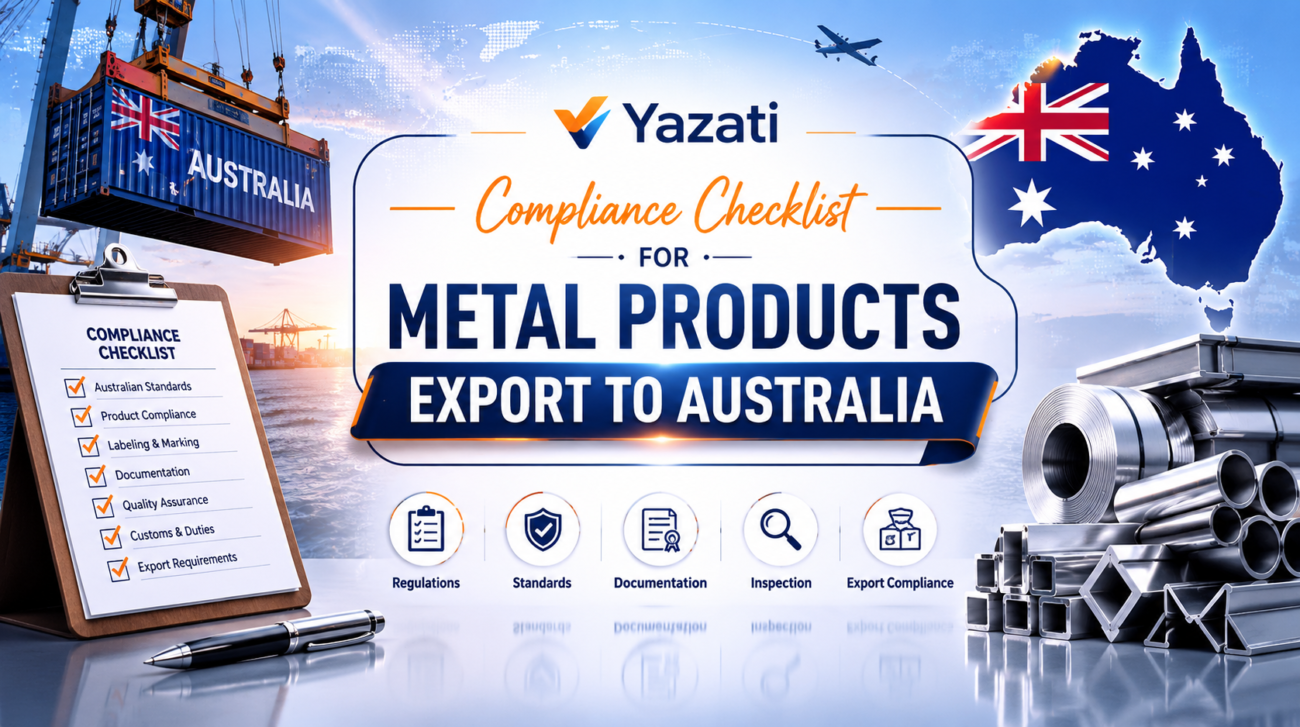
Exporting metal products to Australia can be highly profitable, but it also comes with strict compliance requirements. Australian authorities enforce rigorous standards related to product safety, customs documentation, quality certifications, packaging, and environmental regulations. Businesses that fail to meet these requirements may face shipment delays, penalties, or rejected consignments.
This comprehensive guide provides a detailed Compliance Checklist for Metal Products Export to Australia to help manufacturers, suppliers, and exporters streamline their shipping process and avoid costly mistakes.
Understanding Australia’s Metal Import Regulations
Australia maintains strict import laws to ensure product quality, consumer safety, and environmental protection. Metal product exporters must comply with standards established by Australian regulatory agencies before products enter the market.
The primary agencies involved include:
- Australian Border Force (ABF)
- Department of Agriculture, Fisheries and Forestry
- Standards Australia
- Australian Competition and Consumer Commission (ACCC)
Failure to meet regulatory standards may lead to:
- Cargo seizure
- Heavy fines
- Delayed customs processing
- Product recalls
Role of Australian Border Force
The Australian Border Force monitors imported goods entering Australia. It ensures imported metal products comply with:
- Tariff classifications
- Customs declarations
- Safety regulations
- Trade agreements
Exporters should review the official Australian Border Force website regularly for updates:
https://www.abf.gov.au/
Importance of Product Compliance
Compliance is not only about avoiding penalties. It also helps exporters:
- Build trust with Australian buyers
- Improve customs clearance speed
- Reduce inspection risks
- Enhance market reputation
Types of Metal Products Exported to Australia
Australia imports a wide range of metal products for construction, mining, manufacturing, and infrastructure projects.
Structural Steel Products
These include:
- Steel beams
- Pipes
- Reinforcement bars
- Structural frames
Such products often require compliance with Australian construction standards.
Aluminum Products
Common aluminum exports include:
- Window frames
- Industrial sheets
- Extruded components
- Automotive parts
Stainless Steel Components
Stainless steel products are widely used in:
- Food processing
- Medical equipment
- Construction projects
Industrial Machinery Parts
Metal machinery components must meet performance and durability requirements under Australian industrial regulations.
Mandatory Documentation Requirements
One of the most important parts of the Compliance Checklist for Metal Products Export to Australia is preparing complete and accurate shipping documentation.
Commercial Invoice
The commercial invoice should include:
- Exporter details
- Buyer details
- Product description
- Quantity and weight
- Unit value
- Currency used
- Country of origin
Packing List
The packing list must clearly mention:
- Number of packages
- Packaging dimensions
- Gross and net weight
- Package markings
Bill of Lading
This serves as proof of shipment and transportation contract.
Certificate of Origin
This certificate may help importers claim preferential tariff treatment under trade agreements.
Australian Standards for Metal Products
Australian standards ensure imported products are safe and fit for purpose.
AS/NZS Standards
Metal products may need to comply with Australian/New Zealand Standards (AS/NZS), depending on product type.
Examples include:
| Product Type | Relevant Standard |
|---|---|
| Structural Steel | AS/NZS 3679 |
| Steel Reinforcement | AS/NZS 4671 |
| Welding Materials | AS/NZS 1554 |
| Stainless Steel Tubes | AS 1528 |
ISO Certifications
Many Australian buyers prefer suppliers with:
- ISO 9001 (Quality Management)
- ISO 14001 (Environmental Management)
- ISO 45001 (Occupational Safety)
Product Testing Requirements
Products may require:
- Tensile testing
- Chemical composition analysis
- Corrosion resistance testing
- Load testing
Independent laboratories often perform these tests.
Customs and Tariff Compliance
HS Codes Classification
Correct HS code classification is essential for customs clearance.
Incorrect classification may result in:
- Higher duties
- Delays
- Compliance investigations
Import Duties and GST
Australia generally applies:
- Customs duty (varies by product)
- 10% Goods and Services Tax (GST)
Certain free trade agreements may reduce or eliminate duties.
Customs Clearance Procedures
Importers or customs brokers submit declarations electronically through Australia’s Integrated Cargo System.
Packaging and Labeling Rules
Proper packaging protects goods during transport and ensures compliance.
Packaging Safety Standards
Metal products should be packed to prevent:
- Corrosion
- Moisture damage
- Physical deformation
Exporters commonly use:
- Rust-proof coatings
- Vacuum packaging
- Protective wrapping
Product Labels and Traceability
Labels should include:
- Product identification
- Batch numbers
- Manufacturer information
- Country of origin
Traceability is especially important for industrial and construction-grade metals.
Biosecurity and Quarantine Regulations
Australia enforces some of the world’s strictest biosecurity laws.
ISPM 15 for Wooden Packaging
Wooden pallets and crates must comply with ISPM 15 requirements, including:
- Heat treatment
- Fumigation
- Official IPPC markings
Non-compliant packaging may be destroyed or returned.
Inspection Procedures
Australian authorities may inspect shipments for:
- Soil contamination
- Insects
- Organic material
- Rust and dirt accumulation
Clean packaging significantly reduces inspection risks.
Environmental and Sustainability Compliance
Environmental regulations are increasingly important in Australia.
Recycling and Waste Rules
Certain products must comply with recycling and waste management policies.
Sustainable packaging is strongly encouraged.
Hazardous Substance Restrictions
Metal coatings and treatments containing hazardous chemicals may face restrictions.
Exporters should verify compliance with Australian environmental laws.
Quality Assurance and Testing
Quality assurance plays a major role in successful exports.
Third-Party Inspection
Independent inspections help verify:
- Product dimensions
- Material composition
- Welding quality
- Surface treatment
Material Test Certificates
Mill Test Certificates (MTCs) provide evidence of material properties and production standards.
These certificates are commonly requested by Australian buyers.
Logistics and Shipping Considerations
Efficient logistics planning reduces risks and delays.
Freight Forwarding Requirements
Experienced freight forwarders can assist with:
- Customs coordination
- Shipping documentation
- Cargo insurance
- Compliance verification
Marine Insurance
Marine cargo insurance protects exporters against:
- Transit damage
- Theft
- Weather-related losses
Common Challenges in Metal Product Exports
Delayed Customs Clearance
Delays often occur because of:
- Missing certificates
- Incorrect HS codes
- Packaging non-compliance
Incorrect Documentation
Even small invoice errors may cause customs holds.
Non-Compliance Penalties
Penalties may include:
- Fines
- Shipment rejection
- Increased inspections on future shipments
Best Practices for Smooth Export Operations
Partnering with Compliance Experts
Work with:
- Customs brokers
- Freight forwarders
- Compliance consultants
- Accredited testing agencies
This minimizes regulatory risks.
Maintaining Updated Regulations
Australian regulations may change frequently. Exporters should regularly monitor updates from official government agencies.
FAQs
What documents are required for exporting metal products to Australia?
Typically, exporters need a commercial invoice, packing list, bill of lading, certificate of origin, and applicable test certificates.
Do metal products require Australian certification?
Some metal products must comply with AS/NZS standards and may require third-party testing or certification.
What is ISPM 15 compliance?
ISPM 15 regulates wooden packaging materials used in international trade to prevent pest contamination.
Are metal imports subject to GST in Australia?
Yes, most imported goods are subject to a 10% GST.
Can incorrect HS codes cause shipment delays?
Yes, wrong HS classifications may result in customs inspections, penalties, or delayed clearance.
Why are Mill Test Certificates important?
They verify the material composition and quality of metal products, helping buyers confirm compliance.
Conclusion
Following a proper Compliance Checklist for Metal Products Export to Australia is essential for successful international trade. Exporters must ensure accurate documentation, compliance with Australian standards, proper packaging, customs readiness, and quality assurance procedures.
Businesses that proactively manage compliance gain faster customs clearance, stronger buyer confidence, and fewer operational disruptions. By staying informed about Australian regulations and working with qualified logistics and compliance professionals, exporters can build long-term success in the Australian market.
✨ Discover Global Sourcing Excellence with Netyex ✨
Netyex is your trusted B2B sourcing partner, connecting international buyers with India’s finest manufacturers and curated product lines—from handicrafts and home décor to kitchenware, textiles, hospitality essentials, and more. With verified suppliers and end-to-end support, we make global procurement seamless, reliable, and efficient.
👉 Elevate your sourcing experience—explore Netyex today.
📦 Bulk orders & customisation | 🌍 Worldwide delivery | 🤝 Trusted by global buyers
Visit Netyex to source premium Indian products with confidence.