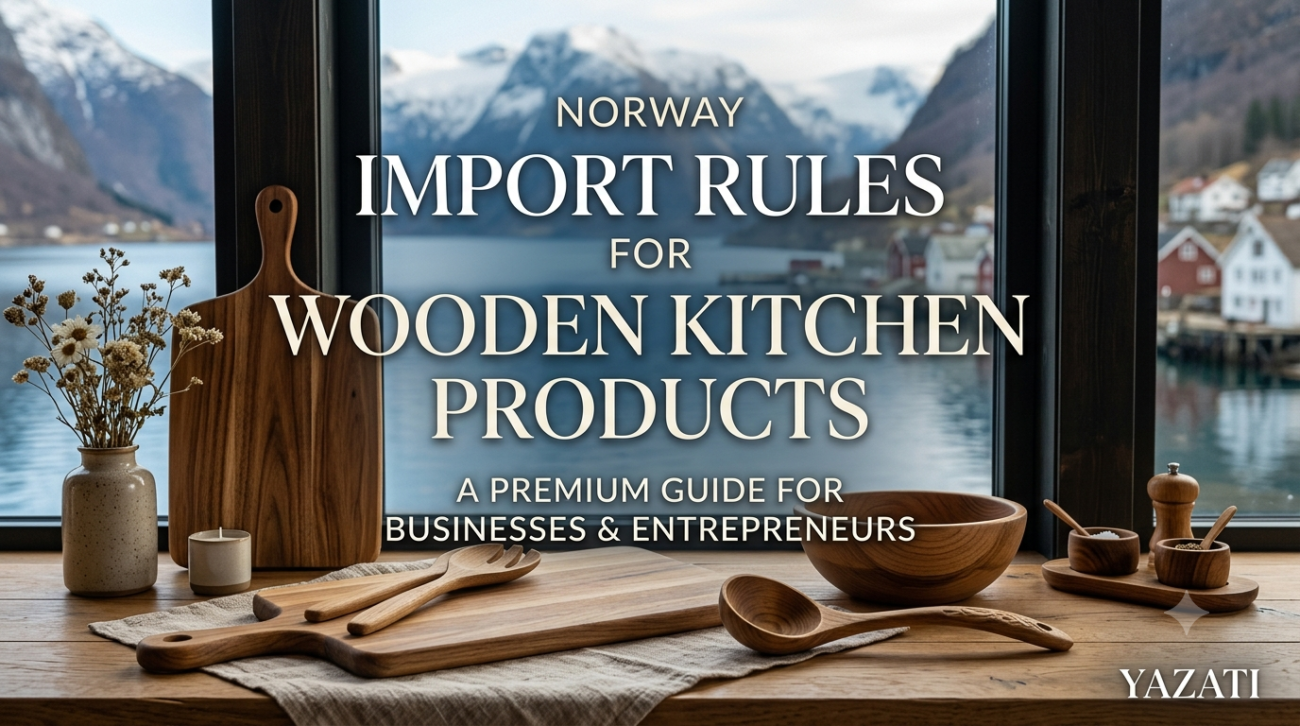
Norway is one of Europe’s most attractive markets for premium wooden kitchen products. Consumers value sustainability, high-quality craftsmanship, and environmentally responsible products, making wooden utensils, cutting boards, serving trays, rolling pins, spatulas, bowls, and kitchen organizers increasingly popular.
However, exporting wooden kitchen products to Norway requires compliance with customs regulations, product safety requirements, timber legality rules, and documentation standards. Failure to comply can lead to shipment delays, customs inspections, additional costs, or even product rejection.
This comprehensive guide explains the latest Norway Import Rules for Wooden Kitchen Products and provides practical advice for exporters, manufacturers, and international traders.
Norway has a strong economy, high purchasing power, and growing consumer demand for eco-friendly household products. Norwegian buyers often prefer products made from natural materials such as bamboo, acacia, beech, oak, olive wood, teak, and rubberwood.
Key reasons exporters target Norway include:
- High demand for sustainable products
- Strong retail market
- Growing online shopping
- Premium pricing opportunities
- Environmentally conscious consumers
Many Norwegian retailers specifically look for responsibly sourced wooden kitchenware that meets European environmental and food safety standards.
Wooden Kitchen Products Covered Under These Rules
The import rules generally apply to products such as:
- Wooden spoons
- Spatulas
- Chopping boards
- Cutting boards
- Serving trays
- Salad bowls
- Rolling pins
- Mortar and pestles
- Wooden coasters
- Bread boxes
- Kitchen organizers
- Wooden tongs
- Ladles
- Measuring spoons
- Wooden plates
Products made entirely from wood or partially from wood may be subject to different regulatory requirements depending on their intended use.
Norwegian Customs Regulations
All imported goods entering Norway must comply with Norwegian Customs procedures.
Importers generally submit customs declarations electronically before goods are released.
Customs authorities verify:
- Product classification
- Customs value
- Country of origin
- Import documentation
- Applicable taxes
- Product compliance
Using the correct Harmonized System (HS) code is essential to determine duty rates and regulatory requirements.
Required Import Documentation
Proper documentation helps ensure efficient customs clearance.
Typical documents include:
Commercial Invoice
Should include:
- Seller details
- Buyer information
- Product description
- Quantity
- Unit price
- Total value
- Country of origin
Packing List
Includes:
- Carton count
- Gross weight
- Net weight
- Product dimensions
- Packaging details
Bill of Lading or Air Waybill
Acts as proof of shipment and transport.
Certificate of Origin
May be required depending on trade agreements or buyer requests.
Import Declaration
Filed with Norwegian Customs before goods are released.
Timber Legality Requirements
Norway places strong emphasis on preventing illegal logging and promoting sustainable forestry.
Exporters should ensure that wood originates from legal and responsibly managed forests.
Common supporting documents include:
- FSC certification
- PEFC certification
- Supplier declarations
- Harvest permits
- Chain of custody documentation
Although certification may not always be mandatory, many Norwegian importers strongly prefer certified wood products.
ISPM 15 Requirements for Wooden Packaging
One of the most overlooked regulations concerns wooden shipping materials.
If shipments use:
- Wooden pallets
- Wooden crates
- Wooden dunnage
they generally must comply with the ISPM 15 standard.
Requirements include:
- Heat treatment
- Approved marking
- Pest-free packaging
This rule applies to packaging—not necessarily to the wooden kitchen products themselves.
Food Contact Material Requirements
Wooden kitchen utensils that come into contact with food must be safe for consumers.
Products should not release harmful substances into food.
Manufacturers should ensure:
- Safe raw materials
- Food-grade finishes
- Food-safe adhesives
- Food-safe oils
- Food-safe coatings
Many importers request laboratory testing before placing large orders.
Chemical Restrictions
Wooden kitchen products should not contain hazardous chemicals.
Manufacturers should avoid:
- Toxic varnishes
- Heavy metals
- Harmful preservatives
- Unsafe paints
- Restricted chemical coatings
Food-contact finishes should comply with applicable European safety expectations.
Product Quality Expectations
Norwegian buyers generally expect:
- Smooth finishing
- No splinters
- Proper sanding
- Durable construction
- Moisture resistance
- Crack-free surfaces
Premium quality often leads to repeat business.
Labelling Requirements
Product labels should clearly provide important information.
Typical information includes:
- Product name
- Material type
- Country of origin
- Importer details
- Care instructions
- Food-contact suitability
Retail packaging should be professional and easy to understand.
Customs Duties and VAT
Imported wooden kitchen products may be subject to:
- Customs duty (depending on tariff classification and origin)
- Import VAT
- Customs processing fees
The exact duty rate depends on the applicable HS code and any preferential trade agreements. Norway generally applies a standard VAT rate to imported consumer goods, collected at import unless other arrangements apply.
Exporters should work closely with their Norwegian importer or customs broker to confirm the correct tariff treatment.
Sustainability Trends in Norway
Sustainability is a significant purchasing factor.
Norwegian consumers increasingly prefer:
- FSC-certified wood
- Plastic-free packaging
- Recyclable materials
- Renewable resources
- Minimal packaging waste
- Carbon-conscious production
Demonstrating environmental responsibility can strengthen relationships with retailers and distributors.
Common Customs Mistakes
Avoid these frequent errors:
- Incorrect HS code classification.
- Missing or incomplete commercial invoices.
- Failure to meet ISPM 15 requirements for wooden pallets.
- Unclear product descriptions.
- Missing country-of-origin information.
- Inadequate packaging.
- Using non-food-safe coatings on kitchenware.
- Inconsistent documentation across shipping papers.
Careful preparation helps reduce delays and additional inspection costs.
Best Practices for Exporters
To improve the likelihood of smooth imports into Norway:
- Source wood from legal, traceable suppliers.
- Use food-safe finishes and adhesives.
- Ensure wooden packaging complies with ISPM 15 where applicable.
- Maintain complete technical and shipping documentation.
- Verify the correct HS code before export.
- Provide clear labeling and care instructions.
- Consider third-party testing for food-contact safety.
- Communicate closely with your Norwegian importer regarding any product-specific requirements.
Frequently Asked Questions
1. Can wooden kitchen products be imported into Norway?
Yes. Wooden kitchen products can be imported provided they comply with applicable customs, product safety, and food-contact requirements.
2. Is FSC certification mandatory?
Not always. However, many Norwegian buyers prefer or require FSC or equivalent certification as part of their sourcing policies.
3. Does ISPM 15 apply to the products themselves?
Generally, ISPM 15 applies to solid wood packaging materials (such as pallets and crates), not to the finished wooden kitchen products.
4. Are food-safe coatings required?
Products intended to contact food should use finishes, oils, adhesives, and coatings that are suitable for food-contact applications.
5. What documents are usually required?
Common documents include a commercial invoice, packing list, transport document, customs declaration, and, where applicable, a certificate of origin or supporting documentation for timber legality.
6. How can exporters avoid customs delays?
Accurate documentation, correct tariff classification, compliant packaging, and meeting product safety requirements are the most effective ways to minimize delays.
Conclusion
Understanding Norway Import Rules for Wooden Kitchen Products is essential for exporters seeking long-term success in the Norwegian market. Compliance extends beyond customs paperwork to include legal timber sourcing, food-contact safety, proper labeling, and suitable packaging.
By investing in high-quality manufacturing, maintaining complete documentation, and aligning with Norway’s strong sustainability expectations, exporters can build trust with importers, reduce clearance issues, and position their products competitively. Staying informed about regulatory updates and working with experienced customs professionals will help ensure that shipments reach Norwegian customers efficiently and in full compliance.
For official guidance and updates, consult the Norwegian Customs authority and the Norwegian Food Safety Authority through their official websites before shipping.
✨ Discover Global Sourcing Excellence with Netyex ✨
Netyex is your trusted B2B sourcing partner, connecting international buyers with India’s finest manufacturers and curated product lines—from handicrafts and home décor to kitchenware, textiles, hospitality essentials, and more. With verified suppliers and end-to-end support, we make global procurement seamless, reliable, and efficient.
👉 Elevate your sourcing experience—explore Netyex today.
📦 Bulk orders & customisation | 🌍 Worldwide delivery | 🤝 Trusted by global buyers
Visit Netyex to source premium Indian products with confidence.